Paycheck budget: how to budget by paycheck on any pay schedule
Budget the way your money arrives: a method for each pay schedule, a worked biweekly example, and a plan for three-paycheck months.
Try it for free on Google Play
Spendguin is our product, so we're a biased source. Spendguin is an Android budgeting app that shows what's left to spend today by reading purchase alerts from your bank and wallet apps. No bank login. Where the research is mixed, we say so, and no study has tested Spendguin itself. 🐧
Why a monthly budget doesn't fit every paycheck
Most budget advice assumes you're paid once a month. Most people aren't. In the US, the most common pay schedule is every two weeks: in February 2023, 43.0% of private employers paid biweekly, 27.0% weekly, 19.8% twice a month and 10.3% monthly (BLS).
If you're paid every two weeks and budget by the month, the numbers never quite line up. Some months have two paychecks and two have three. Rent is due on the 1st, but your paycheck might land on the 26th one month and the 9th the next. A monthly total can look fine while the week before payday is tight.
A paycheck budget fixes that by matching the budget to the money you actually have between paydays. It's the same arithmetic as our daily spending limit guide, done per pay period.
The four pay schedules, side by side
| Schedule | Paychecks a year | Days per period | Extra paychecks |
|---|---|---|---|
| Monthly | 12 | 28 to 31 | None |
| Twice a month (semimonthly) | 24 | 13 to 16 | None |
| Every 2 weeks (biweekly) | 26 | 14 | 2 months have 3 |
| Weekly | 52 | 7 | 4 months have 5 |
Calendar quirks shift these a little. Some years have 27 biweekly paydays or 53 weekly ones, depending on where the first payday falls.
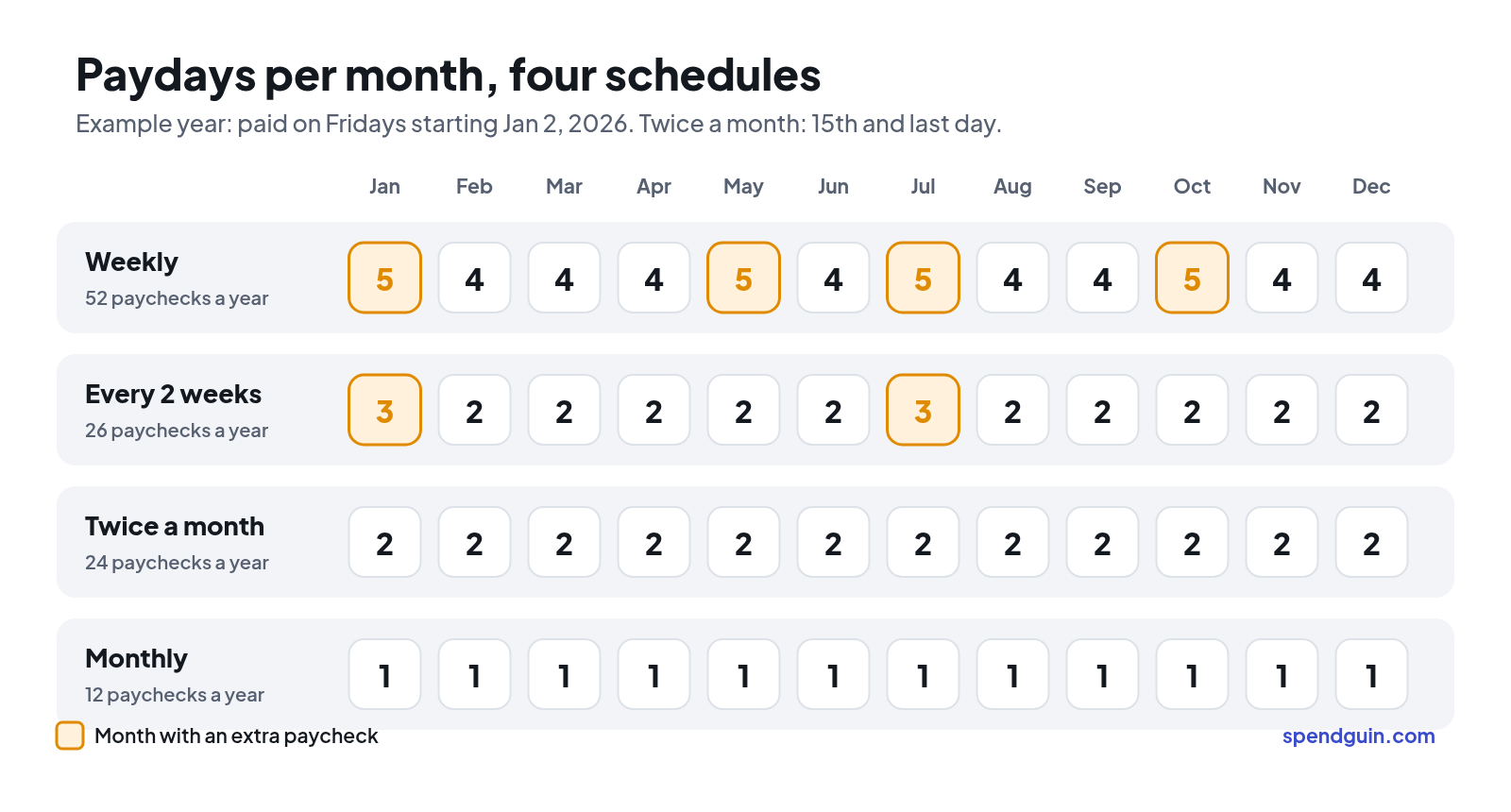 Figure 1. Paydays per month in an example year (paid on Fridays starting January 2, 2026; twice a month on the 15th and last day). Your months will differ with your first payday.
Biweekly vs twice a month: not the same thing
These two get mixed up all the time, and the difference matters for a budget.
- Twice a month means set dates, often the 15th and the last day of the month. You get 24 paychecks a year, always two a month. The periods are uneven: the 1st to the 15th is 15 days, and the 16th to the end is 13 to 16 days.
- Every two weeks means the same weekday every other week. You get 26 paychecks a year. Each one is a bit smaller than a twice-a-month paycheck for the same salary (salary / 26 instead of salary / 24), and the dates drift through the month.
If you're paid twice a month, you can split the month's bills between the two paychecks by due date and the pattern repeats every month. If you're paid every two weeks, the pattern shifts each month, so a steady per-paycheck amount for bills is easier to keep.
How to build a paycheck budget in five steps
1. Start with one paycheck's take-home pay
Use what lands in your account after tax and deductions. If it varies, plan on a typical lower paycheck, not your best one. Variable pay is common: in a Chase account sample, 89% of people saw average monthly income changes above 5% (J.P. Morgan Chase Institute, 2015).
2. Give each paycheck its share of the bills
There are two ways to do this. Pick one.
- Due-date method. List each bill with its due date and pay it from the paycheck that arrives before it. This matches your cash flow exactly, but some paychecks carry more bills than others, so your spending money changes from period to period.
- Even-split method. Add up the monthly bills, multiply by 12 and divide by your paychecks a year. Move that same amount out of every paycheck into the account the bills come from. Your spending money stays the same each period. It works best with a small cushion in the bills account to start, because the bills don't arrive evenly even if the money does.
3. Take out savings and irregular costs
Take savings off the top. Then set aside money for costs that don't come monthly: car registration, gifts, repairs, annual fees. Add up a year of them and divide by your paychecks a year. Surprise costs are common enough to plan for: in a Federal Reserve survey, 63% of US adults said they could cover a $400 emergency with cash or its equivalent, which leaves more than a third who couldn't (Federal Reserve, 2025).
4. Spread what's left over the days to the next payday
What's left is your spending money for this paycheck. Divide it by the days in the period: 7 if you're paid weekly, 14 if every two weeks, and the actual days if you're paid monthly or twice a month. That's your daily number until the next payday. If you'd rather think in a period total, see what "safe to spend" means.
5. Plan the extra paychecks now
Look at the calendar for the year and mark the months with a third (or fifth) paycheck. Decide now what that money is for. More on that below.
A worked example: paid every two weeks
Made-up numbers, not advice for your situation.
| Line | Amount |
|---|---|
| Take-home pay per paycheck | $1,400 |
| Bills: $1,300 a month x 12 / 26 | -$600 |
| Savings | -$100 |
| Irregular costs: $1,560 a year / 26 | -$60 |
| Spending money for the period | $640 |
| Days until the next payday | 14 |
| Daily spending limit | about $45 |
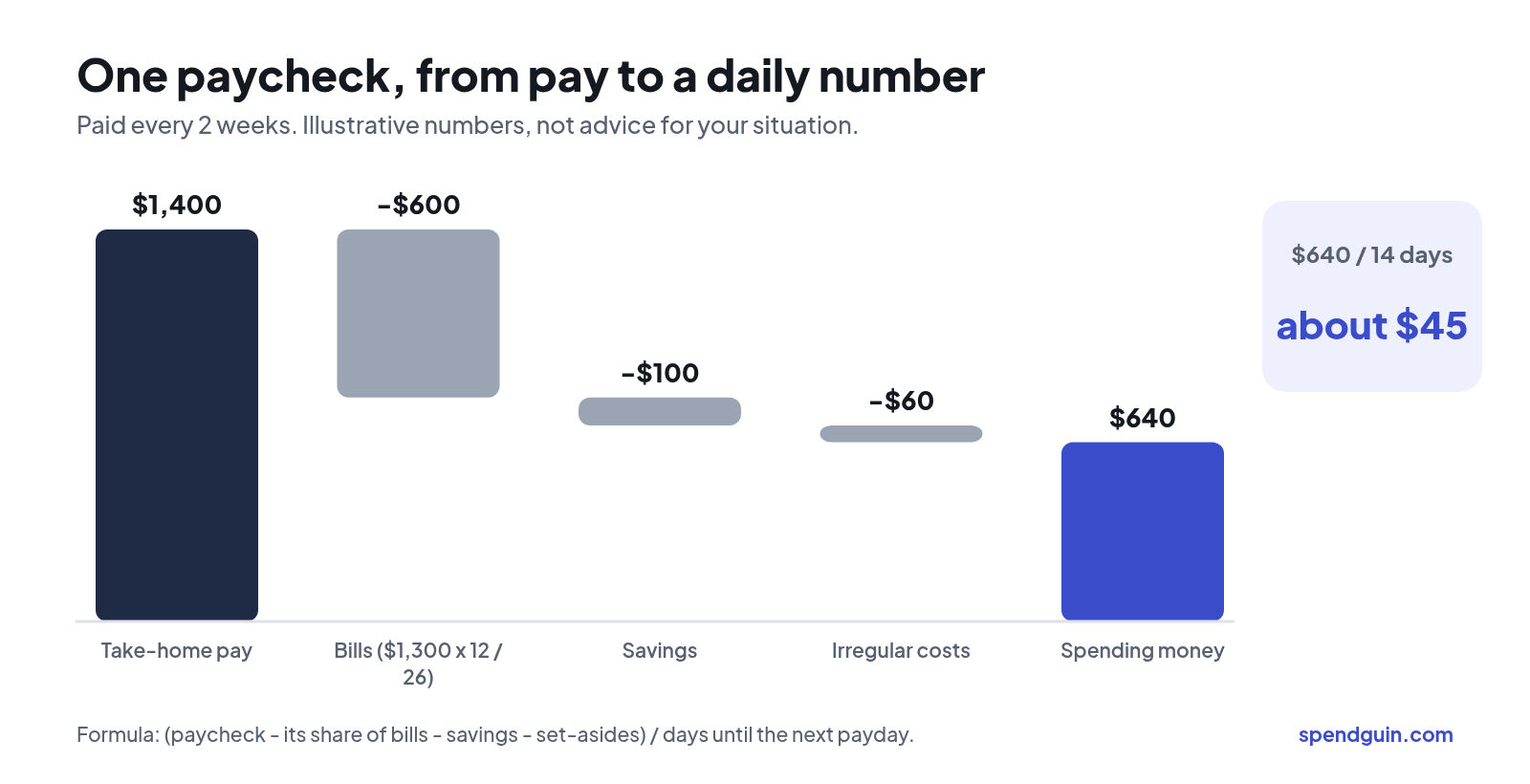 Figure 2. One biweekly paycheck, from take-home pay to a daily number. Illustrative numbers.
With the even-split method, the $600 goes to the bills account every payday, and the two third-paycheck months add an extra $600 of bill money each. Over a year that's 26 x $600 = $15,600, exactly 12 months of $1,300 in bills. In the two-paycheck months, the bills account pays out more than it gets, which is why it needs that starting cushion.
What to do with a third paycheck
If you budget bills from two paychecks a month, a third paycheck has no bills attached. That's the point of the even-split method: it frees those paychecks up. A few common uses:
- Top up savings or an emergency fund.
- Fill the irregular-costs fund before a big annual bill.
- Make an extra debt payment.
- Build the cushion in your bills account.
The one thing to avoid is raising your daily number for that period just because more money arrived. If you want some of it as fun money, decide the amount before payday.
Weekly pay
Weekly pay works the same way with shorter periods. The short periods help: a bad day matters less when payday is never more than a week away. The catch is bills. A $1,200 rent payment due once a month is hard to cover from one weekly paycheck, so the even-split method (monthly bills x 12 / 52 per paycheck) is usually easier than paying each bill from the paycheck before it.
Common mistakes
- Budgeting by the month when you're paid every two weeks. The month looks fine; the week before payday doesn't.
- Treating the third paycheck as income for that month. It's already accounted for if you split bills evenly.
- Forgetting irregular costs. The daily number looks generous until the car needs tires.
- Counting the gross amount. Use what lands in your account.
- Not testing it. Run one full period, then adjust. How to stick to a budget covers what to do after a bad day.
How Spendguin handles each pay schedule
We checked this against the app so the details are exact.
- Monthly: the period runs from a start day you choose (setup starts on the 1st; you can change it in Settings to any day from 1 to 28, such as the day after a statement date).
- Twice a month: two fixed periods, the 1st to the 15th and the 16th to the end of the month.
- Weekly and every 2 weeks: you pick the weekday you're paid and your next payday, and every period starts on a payday and lasts 7 or 14 days.
- The daily amount is your target divided by the days in the period, so a 31-day month gives a slightly smaller daily amount than a 30-day one.
- If you start partway through a period, that first period's budget covers only the days left in it.
- Only the household owner can change the budget, and a partner sees the same shared target (set your spending target).
The target you type is the spending money from step 4 for one period, not your whole paycheck. Spendguin does the dividing and keeps the daily number current as purchases come in. It doesn't know your bills or your bank balance, and it doesn't plan the third paycheck for you.
Where Spendguin fits, and where it doesn't
Spendguin is built for people who want a daily number that matches how they're paid.
- You set one spending target for your pay period (monthly, twice a month, weekly, or every 2 weeks), and Spendguin turns it into a daily amount.
- It picks up purchases from your Google Wallet and bank-app notifications. There's nothing to type, and it never connects to your bank account (no bank login).
- Overspend today and it comes off the days after, within the same pay period. A new period starts fresh: leftover money doesn't roll into it.
- Free: the daily Today screen; alerts on every purchase, when you're getting close to today's amount and when you're over it; the "Recurring?" prompt; refund alerts; 30 days of history; and Together, partner sharing for two people.
- Pro ($4.99 a month or $39.99 a year in USD or CAD, after a 30-day free trial with no card needed, starting when the first purchase notification arrives): spreading a big purchase over several pay periods, a heads-up the day before a recurring charge, a nightly recap and a Monday week-ahead, a choice when a period ends over (spread the overspend across the new period or take it off day one), and full history. Pro features show as locked on Free.
What it doesn't do: it's Android only, it needs notification access, and it can only see what alerts show, so cash and anything without an alert has to be added by hand. It tracks spending you've already made. It doesn't move money or give financial advice. And it hasn't been tested in a controlled trial; we built it on ideas from behavior science, not proof that it changes behavior.
Sources
- U.S. Bureau of Labor Statistics. Length of pay periods in the Current Employment Statistics survey (February 2023 data). Accessed .
- J.P. Morgan Chase Institute (2015). Weathering Volatility: Big data on the financial ups and downs of U.S. individuals. Accessed .
- Board of Governors of the Federal Reserve System (2025). Economic Well-Being of U.S. Households in 2024: Savings and Investments (SHED). Accessed .
- Spendguin help center: Set your spending target. Accessed .
- Spendguin help center: What's left today; How leftover and overage carry. Accessed .
FAQ
How do I budget if I'm paid every two weeks?
Plan one paycheck at a time. Turn your monthly bills into a per-paycheck amount (monthly total x 12 / 26), take that, savings and a set-aside for irregular costs off each paycheck, and divide what's left by the 14 days until the next one. Treat the two months a year with a third paycheck as extra, not as a raise.
What's the difference between biweekly and semimonthly pay?
Biweekly means every two weeks, always on the same weekday: 26 paychecks a year, so two months have three. Semimonthly means twice a month on set dates, such as the 15th and the last day: 24 paychecks a year, never three in a month. Biweekly paychecks are a little smaller each time.
What should I do with a third paycheck?
Decide before it arrives. Common choices are topping up savings, the irregular-costs fund or a debt payment. If you've already budgeted every bill from two paychecks a month, the third one is free of bills, so don't raise your daily number because of it.
Should I budget monthly or by paycheck?
Budget the way your money arrives. If you're paid monthly, a monthly budget fits. If you're paid weekly or every two weeks, a monthly budget hides the gaps between paydays, so budgeting by paycheck usually matches your cash flow better.
How much of each paycheck should go to bills?
There's no standard share. Add up your monthly bills, multiply by 12 and divide by your paychecks a year (26 if every two weeks, 52 if weekly, 24 if twice a month). That's the steady amount each paycheck needs to cover.
Does Spendguin work with biweekly pay?
Yes. Spendguin supports monthly, twice-a-month, weekly and every-2-weeks pay periods. For weekly and every 2 weeks you pick the weekday you're paid and your next payday, and each period starts on a payday.
Spendguin shows what’s left to spend today by reading the purchase alerts you already get. No bank login.