Daily spending limit: how to set one that lasts the whole pay period
A five-step way to turn your pay period into one daily number, with a worked example and a plan for the days you go over.
Try it for free on Google Play
Spendguin is our product, so we're a biased source. Spendguin is an Android budgeting app that shows what's left to spend today by reading purchase alerts from your bank and wallet apps. No bank login. Where the research is mixed, we say so, and no study has tested Spendguin itself. 🐧
Not your card's daily limit
If you searched this, you may have meant the limit your bank puts on a debit or credit card: the most you can spend or withdraw in a day. Banks set those, mostly to limit losses if a card is lost or stolen, and you can usually see or change yours in your bank's app or by calling the bank. This guide is about a different thing: a personal daily budget you choose, so you can see what's left to spend today.
How to set a daily spending limit in five steps
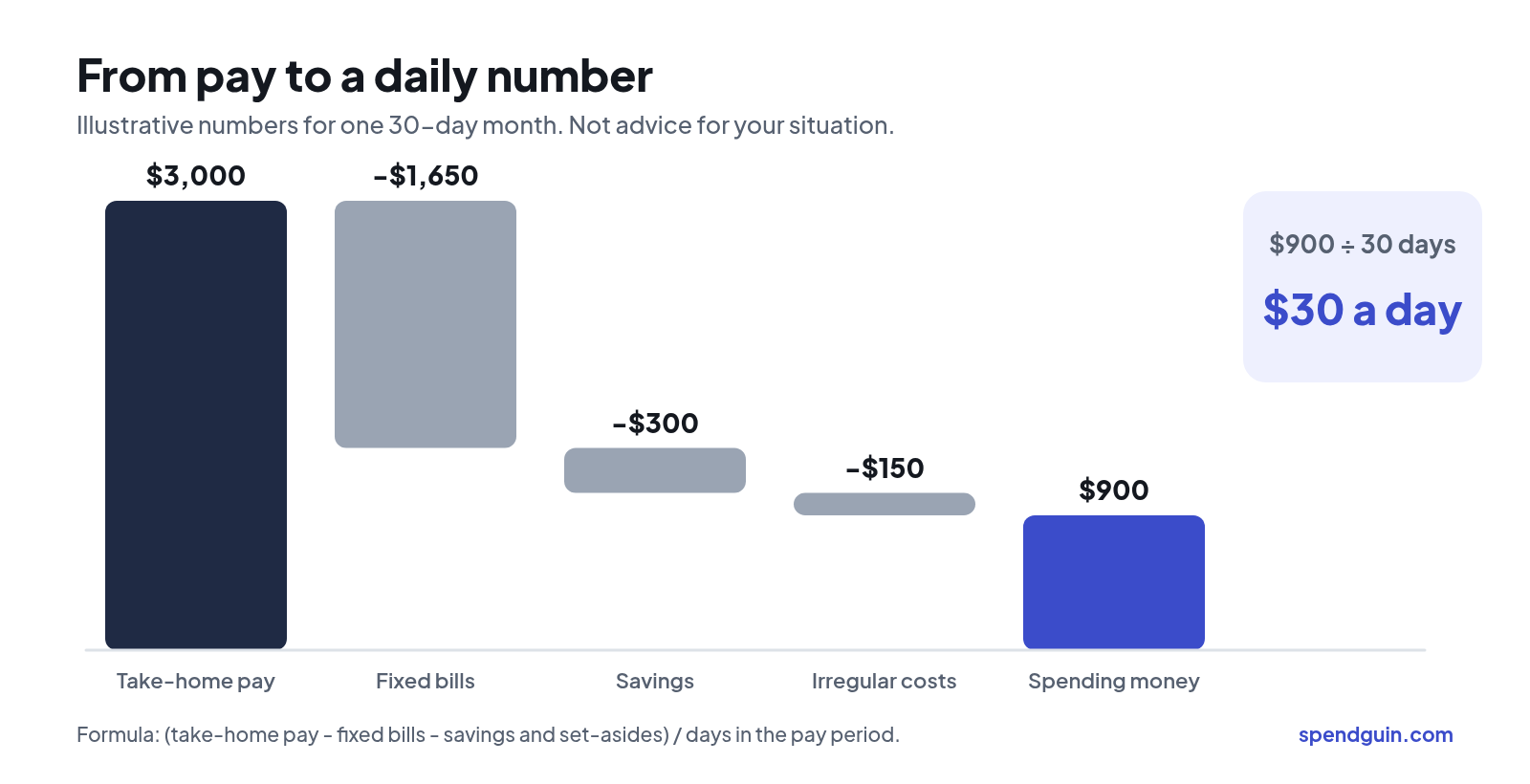 Figure 1. From pay to a daily number. Illustrative numbers, not advice for your situation.
1. Start with take-home pay for one pay period
Use what actually lands in your account, after tax, for the period you're planning: a month, or half a month if you're paid twice a month. If your income varies, use a typical lower month rather than your best one. Budgeting with a partner? Use what you both put toward shared spending; couples budgeting without merging everything covers the common ways to split it. That's common practical advice, not a research finding, but income swings are common: in a Chase account sample, 89% of people saw average monthly income changes above 5% (J.P. Morgan Chase Institute, 2015).
2. Subtract the fixed bills due in that period
Rent or mortgage, utilities, phone, insurance, loan payments and subscriptions. Only count the bills that fall in this period. If you're paid twice a month, split the month's bills between the two periods according to their due dates. Not sure what subscriptions you're paying for? How to track subscriptions has a short audit.
3. Subtract savings and money for irregular costs
Take savings off the top. Then set aside money for costs that don't arrive monthly: car registration, gifts, repairs, annual fees. Add up a year of them and divide by the number of pay periods in a year (12 if monthly, 24 if twice a month, 26 if every 2 weeks, 52 if weekly). Skipping this step is the most common way a daily number looks generous and then collapses. Surprises are common: in a Federal Reserve survey, 63% of US adults said they could cover a $400 emergency with cash or its equivalent, which leaves more than a third who couldn't (Federal Reserve, 2025).
4. Divide by the days in the period
What's left is your flexible spending money. Divide it by the days in the period. A monthly period has 28 to 31 days; a twice-a-month period is about 15. Worked example with made-up numbers:
| Line | Amount |
|---|---|
| Take-home pay for the month | $3,000 |
| Fixed bills due this month | -$1,650 |
| Savings | -$300 |
| Set aside for irregular costs | -$150 |
| Flexible spending money | $900 |
| Days in the period | 30 |
| Daily spending limit | $30 |
5. Decide what counts
Write down which purchases come out of the daily number. Most people include groceries, eating out, coffee, transport and small shopping, and leave out the fixed bills you already subtracted. Be consistent; a number that ignores half your spending isn't telling you much.
Good days, bad days: decide a carry rule
A daily number only works if a bad day doesn't end the experiment. Pick a rule before you start:
- Spend less today: tomorrow's number grows by the difference.
- Spend more today: the overage comes off the days that follow, so the period still aims at your total.
- At the end of the period: start fresh, or decide what happens to any overspend.
The research is mixed in a useful way. In a technical report on budget monitoring, precise, real-time budget feedback could actually raise spending late in a period when people had money left over, because it told them how much they could safely spend; the effect was weaker with rollovers, shorter windows and less precise information (Ghosh & Huang, 2020). A daily window with carry-forward inside the period is one way to apply that. If you'd rather start from your account balance than your income, see what "safe to spend" means.
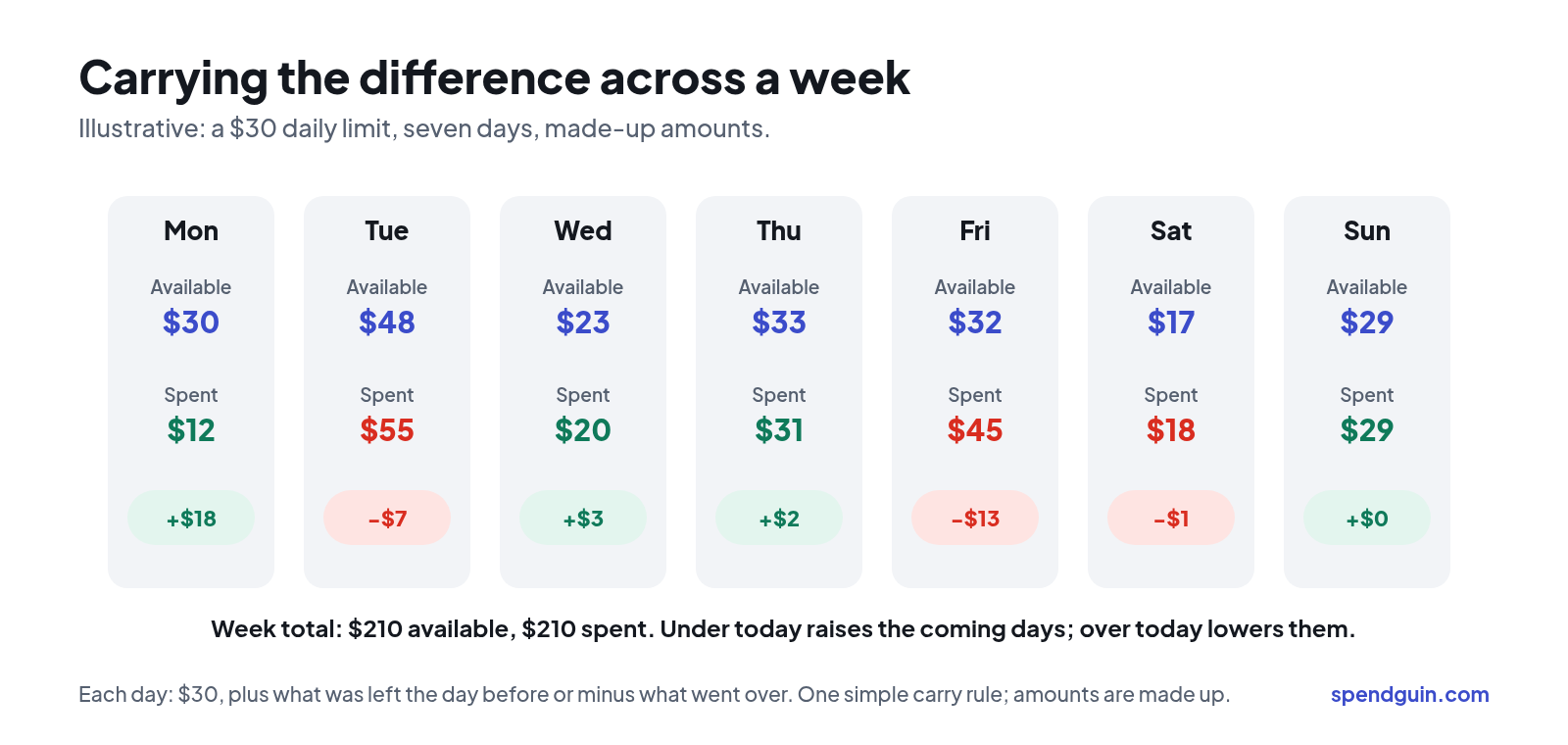 Figure 2. How carrying the difference works across one week. Illustrative numbers.
Daily limits by pay schedule
| Pay schedule | Periods a year | Days per period | Set-aside divisor |
|---|---|---|---|
| Monthly | 12 | 28 to 31 | 12 |
| Twice a month (e.g. 1st and 15th) | 24 | about 15 | 24 |
| Every two weeks | 26 | 14 | 26 |
| Weekly | 52 | 7 | 52 |
Twice a month and every two weeks are different: every-two-weeks pay means two months a year with a third paycheck. Spendguin supports monthly, twice-a-month, weekly, and every-2-weeks pay periods, so you can set the target in the app for any of those schedules. For a full walkthrough by schedule, including what to do with a third paycheck, see the paycheck budget guide.
Common mistakes
- Forgetting irregular costs. The number looks fine until the car needs tires.
- Using your best month's income. Plan on a typical month instead.
- Checking the number after spending, not before. It works best as a glance before a purchase you didn't plan; see the real-time spending tracker guide.
- Treating one bad day as failure. That's what the carry rule is for; how to stick to a budget covers the day after.
- Never adjusting. After one full period, change the number if it was clearly too tight or too loose.
Is a daily limit better than a monthly budget?
We don't know, and we won't claim it. A daily number gives feedback closer to each choice, which fits the research: a meta-analysis of 138 randomized trials found that monitoring progress improved goal attainment, with a small-to-moderate effect (Harkin et al., 2016). But in a 13-week test with 9,035 budgeting-app users, a weekly one-number budget and a category budget both left average spending unchanged against a control group, and most people rarely looked at their budget (Irrational Labs). The number only helps if you look at it. Our pillar guide, why budgets fail, covers the evidence in detail, and how to change your spending habits covers making the glance a habit.
Where Spendguin fits, and where it doesn't
Spendguin does the arithmetic in this guide for you and keeps the daily number current as you spend.
- You set one spending target for your pay period (monthly, twice a month, weekly, or every 2 weeks), and Spendguin turns it into a daily amount.
- It picks up purchases from your Google Wallet and bank-app notifications. There's nothing to type, and it never connects to your bank account (no bank login).
- Overspend today and it comes off the days after, within the same pay period. A new period starts fresh: leftover money doesn't roll into it.
- Free: the daily Today screen; alerts on every purchase, when you're getting close to today's amount and when you're over it; the "Recurring?" prompt; refund alerts; 30 days of history; and Together, partner sharing for two people.
- Pro ($4.99 a month or $39.99 a year in USD or CAD, after a 30-day free trial with no card needed, starting when the first purchase notification arrives): spreading a big purchase over several pay periods, a heads-up the day before a recurring charge, a nightly recap and a Monday week-ahead, a choice when a period ends over (spread the overspend across the new period or take it off day one), and full history. Pro features show as locked on Free.
What it doesn't do: it's Android only, it needs notification access, and it can only see what alerts show, so cash and anything without an alert has to be added by hand. It tracks spending you've already made. It doesn't move money or give financial advice. And it hasn't been tested in a controlled trial; we built it on ideas from behavior science, not proof that it changes behavior.
Sources
- Harkin, B., et al. (2016). Does monitoring goal progress promote goal attainment? A meta-analysis of the experimental evidence. Psychological Bulletin, 142(2), 198-229. Accessed .
- Ghosh, A. P., & Huang, L. (2020). Dynamic budget monitoring: When access to budget feedback leads to increase in spending. Technical report for the Think Forward Initiative. Accessed .
- Irrational Labs / Common Cents Lab. Budgeting: What our research uncovered. Field experiment with 9,035 budgeting-app users (industry report). Accessed .
- J.P. Morgan Chase Institute (2015). Weathering Volatility: Big data on the financial ups and downs of U.S. individuals. Accessed .
- Board of Governors of the Federal Reserve System (2025). Economic Well-Being of U.S. Households in 2024: Savings and Investments (SHED). Accessed .
- Spendguin help center: Set your spending target. Accessed .
- Spendguin help center: What's left today; Going over today. Accessed .
FAQ
How do I work out a daily spending limit?
Take your take-home pay for the pay period, subtract the fixed bills due in that period, subtract savings and money set aside for irregular costs, then divide what's left by the number of days in the period. For example, $900 of spending money over a 30-day month is $30 a day.
How much can I spend per day?
There's no universal number; it depends on your income, bills and goals. Work it out from your own pay period: (take-home pay - fixed bills - savings and set-asides) / days in the period. Then test it for a full period and adjust.
Is this the same as my debit card's daily limit?
No. A card's daily spending or withdrawal limit is set by your bank, mostly to limit losses if the card is lost or stolen, and you can usually see it in your bank's app or by asking the bank. A personal daily spending limit is a budget number you choose.
What happens if I go over my daily limit?
Nothing breaks. Decide a carry rule in advance: going over today comes off the days that follow, and spending less leaves more for later days, within the same pay period. Spendguin works this way. A new period starts fresh.
Should groceries be part of my daily limit?
It's your choice. Many people include everyday flexible spending such as groceries, eating out, coffee and transport, and leave out fixed bills. Including groceries makes the number bigger and more realistic; excluding them means you need a separate grocery amount.
Is a daily budget better than a monthly one?
Not proven. A daily number gives feedback closer to each choice, which fits the research on timing and monitoring, but no study we found compares daily and monthly budgets head to head.
Spendguin shows what’s left to spend today by reading the purchase alerts you already get. No bank login.