Couples budgeting without merging everything
Four ways couples split money, how to pick one, how to talk about it without blame, and how to share one spending number without merging accounts.

Try it for free on Google Play
Spendguin is our product, so we're a biased source. Spendguin is an Android budgeting app that shows what's left to spend today by reading purchase alerts from your bank and wallet apps. No bank login. Where the research is mixed, we say so, and no study has tested Spendguin itself. 🐧
Do couples have to merge their money?
No, and most don't merge all of it. In a Bankrate survey of US adults who are married or living with a partner, 38% said they completely combine their finances, 36% use a mix of joint and separate accounts, and 26% keep their accounts completely separate (Bankrate, 2026). Census data on married couples shows the same drift over time: the share with no joint bank account rose from 15% in 1996 to 23% in 2023 (U.S. Census Bureau, 2025).
There is research on the other side, and it's worth knowing. In a two-year experiment, 230 engaged or newlywed couples who all started with separate accounts were randomly assigned to open a joint account, keep their accounts separate, or do whatever they liked. Couples told to merge into a joint account kept stronger relationship quality across the two years; the other two groups showed the usual decline (Olson et al., 2023). It's one study of early-marriage, male-female couples in the US, and one of the authors notes the benefit might not hold for everyone: a joint account means giving up some independence, and it can put someone at risk when one partner tries to control the other (Kellogg Insight).
So the question isn't really "joint or separate". It's whether you both know the plan and can see how it's going. That part doesn't need merged accounts.
Four ways couples budget
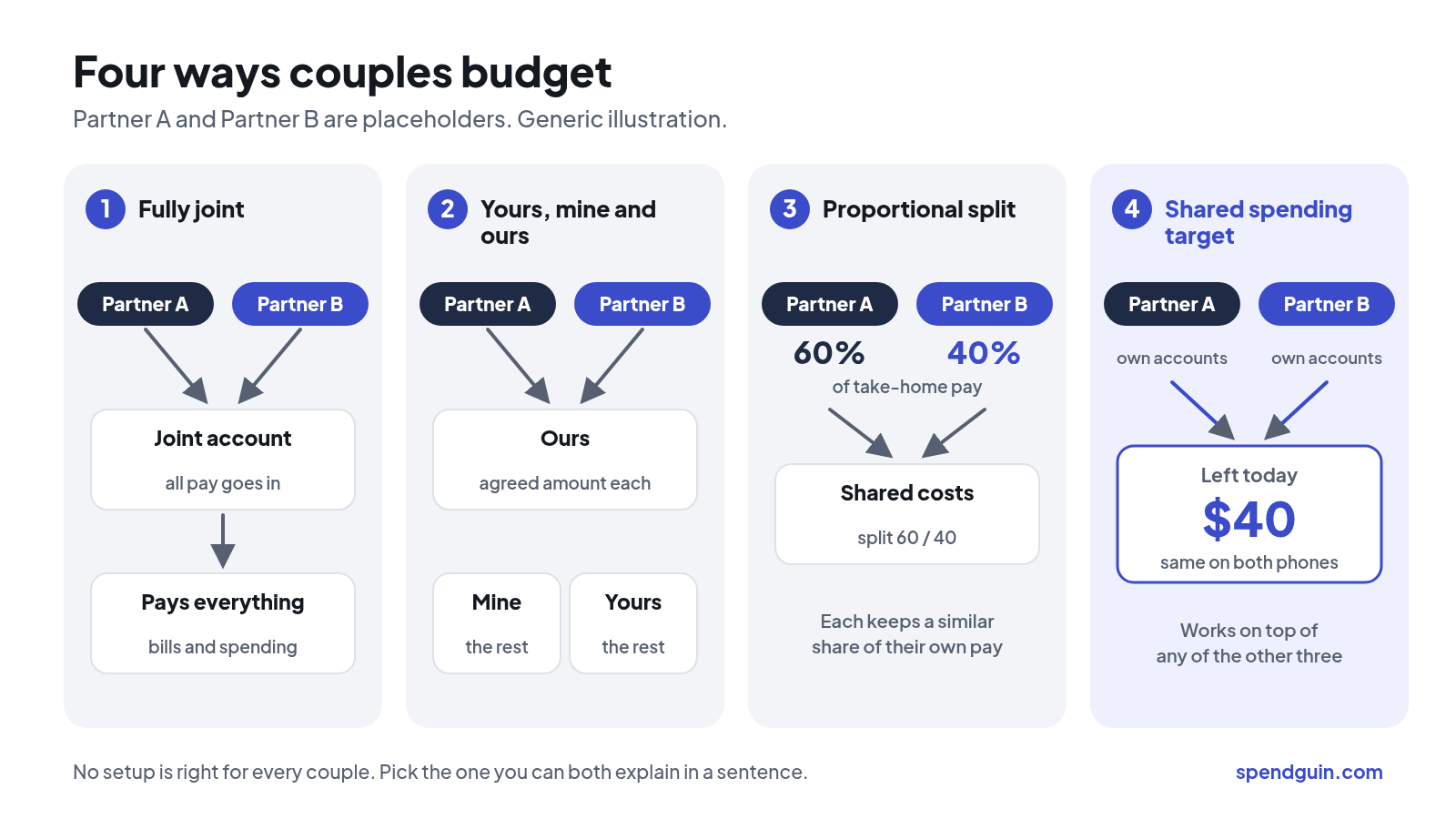 Figure 1. Four common setups. Generic illustration; Partner A and Partner B are placeholders.
| Setup | How it works | Works well when | Watch out for |
|---|---|---|---|
| Fully joint | Both paychecks land in one account that pays for everything. | You think of all money as shared and trust each other's spending. | Every purchase is visible to both, which some people find stressful. |
| Yours, mine and ours | Each partner puts an agreed amount into a shared account for bills and shared spending, and keeps the rest. | You want shared bills handled and some independence. | Deciding how much each puts in, and what counts as "ours". |
| Proportional split | Shared costs are split by share of take-home pay, for example 60/40. | Incomes are quite different. | Needs updating when either income changes. |
| Shared spending target | Accounts stay as they are; you agree on one spending amount for the pay period and both track against it. | You want to stay on the same page without moving money around. | It only covers what you both agree counts. |
The last one isn't really an account setup. It's a layer you can add to any of the first three. Fully joint couples use it to stop arguing about the joint card. Separate-account couples use it so that groceries, takeout and household shopping have one limit, whoever pays.
The proportional split, worked out
A 50/50 split feels fair until incomes differ a lot. Here's an example with made-up numbers: Partner A takes home $4,500 a month and Partner B takes home $3,000, so A earns 60% of the household's take-home pay. Shared costs are $4,000 a month.
- 50/50: each pays $2,000. A keeps $2,500 and B keeps $1,000.
- Split by income (60/40): A pays $2,400 and B pays $1,600. A keeps $2,100 and B keeps $1,400.
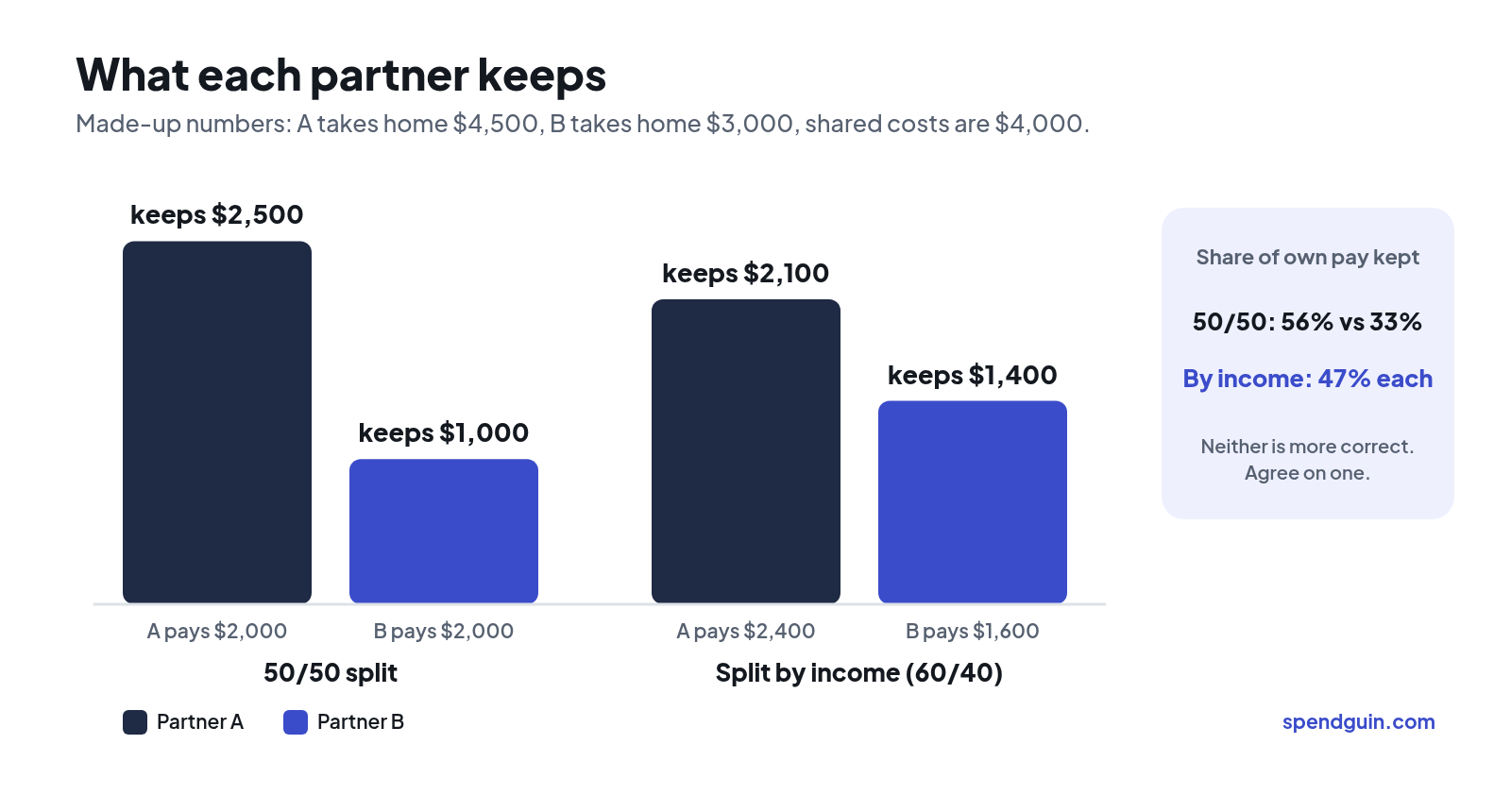 Figure 2. Same shared costs, two ways to split them. Made-up numbers, not advice for your situation.
Neither is more correct. A proportional split means both partners keep the same share of their own pay (about 47% each here). Some couples prefer 50/50 for bills and proportional for savings, or the other way round. What matters is that you both agreed and wrote it down.
How to pick a setup
Talk through these together. You don't need perfect answers, just shared ones.
- Do you want to see each other's personal spending? If not, keep a personal amount each and only share what's shared.
- How different are your incomes? Far apart usually points toward a proportional split.
- Who pays which bills today? Start from what already works and change the least.
- What counts as shared? Write a short list: groceries, household supplies, eating out together, kids' costs, the car. Anything not on the list is personal.
- How big a purchase needs a talk first? Pick an amount. Below it, nobody asks.
- How will you both see how it's going? A shared spreadsheet, a joint card's statement, or a tracker you both look at.
If one of you earns, holds or controls most of the money, say out loud how the other person gets access to it. Financial control is a recognized form of abuse, not a budgeting style. If money is being used to control you, the National Domestic Violence Hotline has information and support.
How to talk about money without blame
Money arguments tend to stick around. In a diary study of 100 married couples who logged 748 disagreements at home over 15 days, money wasn't the most common topic, but conflicts about money were more likely to recur and stay unresolved than conflicts about other things (Papp et al., 2009).
A few ways couples keep these talks shorter and calmer. They're common practice, not tested methods:
- Talk about the plan, not the purchase. "We're $60 over this week, what do we want to do?" lands differently from "why did you buy that?"
- Use a number you both agreed on. If the target was set together, going over it is a shared problem, not one person's fault.
- Protect personal money. If each person has an amount that's theirs, small purchases stop being evidence in an argument.
- Pick a time. A short check-in at the same time each week beats bringing it up mid-argument or at the checkout.
- Start with what went well. A cheap week is worth noticing too.
- Change the plan when it's wrong. If you go over every period, the target may be unrealistic. Reset it together instead of trying harder in silence.
How to run one shared number day to day
A shared spending target turns "are we OK this month?" into one figure you can both check. Here's how to set one up, with made-up numbers:
- Agree on the pay period. Use the household's main payday: monthly, twice a month, weekly or every 2 weeks.
- Work out the shared flexible money. Take what you both put toward shared costs, subtract shared bills, savings and set-asides for irregular costs. Say it leaves $1,200 for a 30-day month.
- Turn it into a daily amount. $1,200 over 30 days is $40 a day. The daily spending limit guide walks through the steps.
- Agree what counts. Use your list of shared things from above.
- Both check the same number. Before an unplanned shared purchase, not at the end of the month.
- Agree what happens after an expensive day. Usually the overspend comes off the days after; a cheap day leaves more for later in the period. The safe-to-spend guide explains the two common ways to handle it.
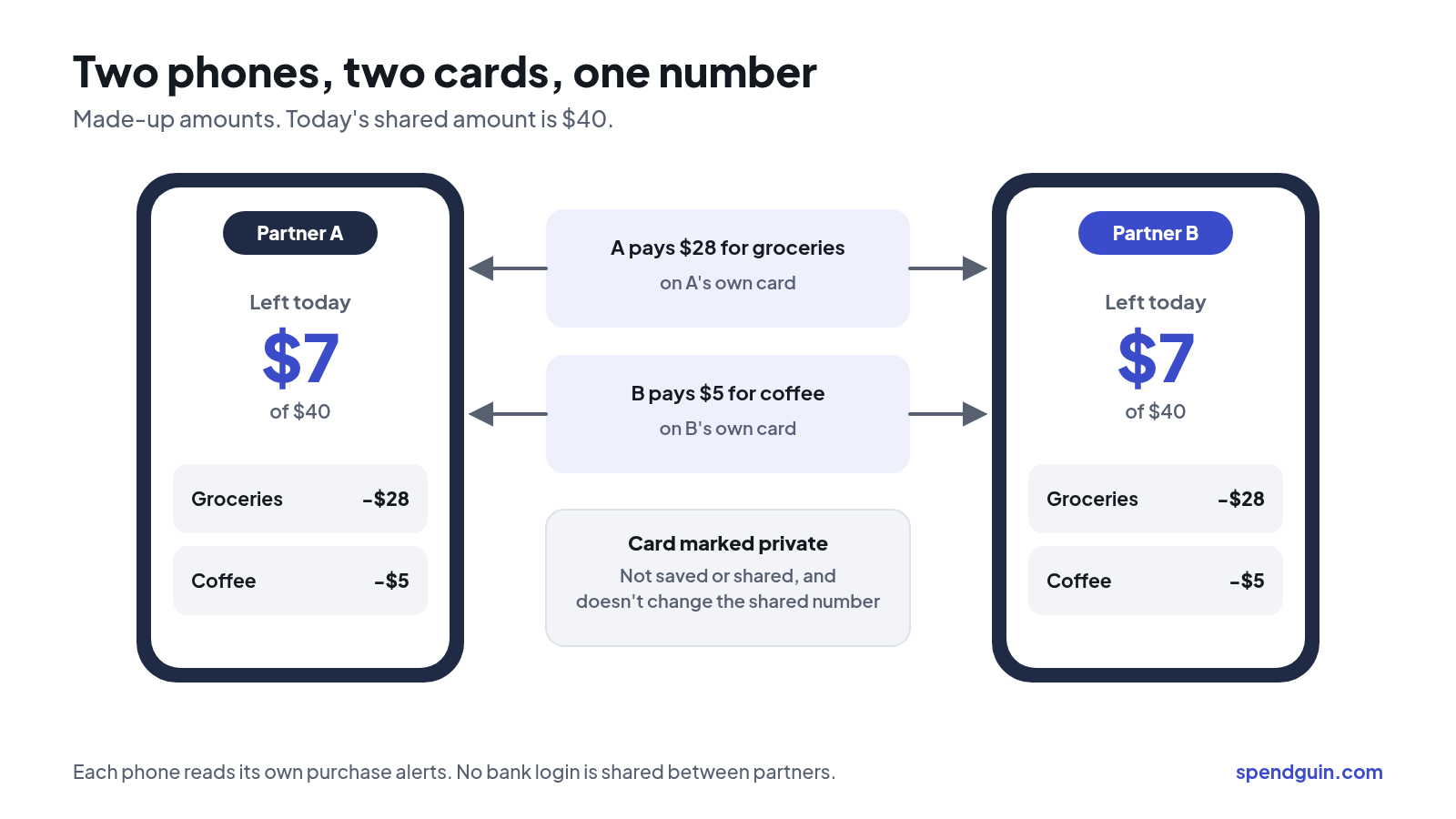 Figure 3. Two phones, two cards, one number. Generic illustration with made-up amounts.
What a shared tracker can do, and what it can't
A shared tracker helps most with the "where did it all go?" part. Instead of piecing together two sets of statements at the end of the month, you both see purchases as they happen against one target.
What it can do:
- Show both partners the same number at the same time.
- Make shared spending visible without either of you handing over a bank login.
- Keep the conversation on the number, not on reconstructing who bought what.
What it can't do:
- Settle who owes whom. That's a bill-splitting job, and a shared budget isn't built for it.
- Replace the conversation. It can show you're over; it can't decide what to cut.
- See what it isn't told about. Cash and purchases without an alert have to be added by hand.
- Make anyone look at it. In a 13-week test with 9,035 budgeting-app users, most people rarely looked at their budget, and average spending didn't change compared with a control group (Irrational Labs). Watching progress toward a goal can help: a meta-analysis of 138 randomized studies found that monitoring progress improved goal attainment, with a small-to-moderate effect (Harkin et al., 2016). A number neither of you checks doesn't do anything.
How Together works in Spendguin
Together is Spendguin's partner sharing. It's free. Here's what the help center says it does (Together overview):
- One household, one budget. One person starts the household and becomes the owner. In Settings, under the household / Together section, they'll find a 6-character invite code to share (invite with a code).
- Joining. The partner installs Spendguin, signs in, chooses Shared with someone, then Join with a code, and enters the code and their name.
- Each phone tracks its own cards. Each person turns on notification access and picks their own bank and wallet apps on their own phone. Nobody shares a bank login, because Spendguin never asks for one.
- What you both see. Shared purchases and the same Today number. Each person manages their own notification switches.
- Who changes what. Only the owner changes the spending target and pay period, and makes the period-end decisions for the household (who can change what).
- Private cards. A card marked private stays private: only the phone that captured it can make it private, its purchases are deleted, and future ones aren't saved or shared. Private cards never sync (counted, not counted, and private). That's one way to keep a personal card out of the shared number.
- What syncs. The alert text stays on the phone that received it. Only the amount, merchant, last card digits and time sync to your household (notification access).
- Pro is per household. If you want Pro, the owner upgrades through Google Play and members share it once it's active.
Both of you need an Android phone. Spendguin has no budget categories: it's one shared number for the things you agreed to count, which suits a shared spending target but not a detailed category budget.
Where Spendguin fits, and where it doesn't
Spendguin is built for the shared-spending-target setup: one number for the pay period, the same on both phones, updated as either of you pays.
- You set one spending target for your pay period (monthly, twice a month, weekly, or every 2 weeks), and Spendguin turns it into a daily amount.
- It picks up purchases from your Google Wallet and bank-app notifications. There's nothing to type, and it never connects to your bank account (no bank login).
- Overspend today and it comes off the days after, within the same pay period. A new period starts fresh: leftover money doesn't roll into it.
- Free: the daily Today screen; alerts on every purchase, when you're getting close to today's amount and when you're over it; the "Recurring?" prompt; refund alerts; 30 days of history; and Together, partner sharing for two people.
- Pro ($4.99 a month or $39.99 a year in USD or CAD, after a 30-day free trial with no card needed, starting when the first purchase notification arrives): spreading a big purchase over several pay periods, a heads-up the day before a recurring charge, a nightly recap and a Monday week-ahead, a choice when a period ends over (spread the overspend across the new period or take it off day one), and full history. Pro features show as locked on Free.
What it doesn't do: it's Android only, it needs notification access, and it can only see what alerts show, so cash and anything without an alert has to be added by hand. It tracks spending you've already made. It doesn't move money or give financial advice. And it hasn't been tested in a controlled trial; we built it on ideas from behavior science, not proof that it changes behavior.
Sources
- Bankrate (February 9, 2026). Most couples keep at least some of their money separate. Online YouGov survey of 2,564 US adults, 1,208 married, in a civil partnership or living with a partner, December 2-8, 2025 (non-probability sample, weighted). Accessed .
- U.S. Census Bureau (September 24, 2025). Almost a quarter of married couples didn't have joint accounts in 2023, up from 15% in 1996 (Survey of Income and Program Participation). Accessed .
- Olson, J. G., Rick, S. I., Small, D. A., & Finkel, E. J. (2023). Common cents: Bank account structure and couples' relationship dynamics. Journal of Consumer Research, 50(4), 704-721. Accessed .
- Kellogg Insight, Northwestern University. One key to a happy marriage? A joint bank account. (Summary of Olson et al., 2023, with author caveats.) Accessed .
- Papp, L. M., Cummings, E. M., & Goeke-Morey, M. C. (2009). For richer, for poorer: Money as a topic of marital conflict in the home. Family Relations, 58(1), 91-103. Diary study of 100 married couples. Accessed .
- Irrational Labs / Common Cents Lab. Budgeting: What our research uncovered. Field experiment with 9,035 budgeting-app users (industry report). Accessed .
- Harkin, B., et al. (2016). Does monitoring goal progress promote goal attainment? A meta-analysis of the experimental evidence. Psychological Bulletin, 142(2), 198-229. Accessed .
- National Domestic Violence Hotline: What is financial abuse? Accessed .
- Spendguin help center: Together overview; Invite with a code; Who can change what. Accessed .
- Spendguin help center: Counted, Not counted, and Private; Turn on notification access (what syncs). Accessed .
FAQ
Should couples combine their finances?
There's no single right answer. In a December 2025 Bankrate survey, 38% of US couples fully combined their finances, 36% mixed joint and separate accounts, and 26% kept everything separate. One two-year experiment with newlyweds found couples assigned to a joint account kept stronger relationship quality, but it studied one group, and the authors note a joint account isn't right in every situation.
What's the fairest way to split expenses as a couple?
Fair is whatever you both agree is fair. A 50/50 split is simple when incomes are similar. When they're not, many couples split shared costs in proportion to take-home pay, so each person keeps a similar share of their own income. Write the rule down so you're not renegotiating it every month.
How much personal spending money should each partner get?
There's no standard amount. Pick a figure each person can spend with no questions asked, either the same for both or in proportion to income, and leave it out of the shared number. The point is that small personal purchases stop being a topic.
Do we need a joint bank account to share a budget?
No. You can keep separate accounts and still agree on a shared spending target for the pay period, then both track against it. A shared tracker that reads purchase alerts on each phone can show you both the same number without either of you sharing a bank login.
How often should couples talk about money?
Research doesn't give a magic frequency. A common habit is a short weekly check-in on the shared number and a longer talk once per pay period to reset the target. Short and regular tends to be easier than rare and long, when every surprise has piled up.
Spendguin shows what’s left to spend today by reading the purchase alerts you already get. No bank login.