How to change your spending habits (and how long a new money habit takes)
How spending habits form, how long a new one takes, and seven steps that fit the research, including what to do after a slip.
Part of the series that starts with Why budgets fail: the feedback delay problem.
Try it for free on Google Play
Spendguin is our product, so we're a biased source. Spendguin is an Android budgeting app that shows what's left to spend today by reading purchase alerts from your bank and wallet apps. No bank login. Where the research is mixed, we say so, and no study has tested Spendguin itself. 🐧
This guide covers both changing a spending habit and building a new money habit, because they're the same process. The research behind it is in our pillar guide, why budgets fail: the feedback delay problem.
Why spending habits are hard to see
Habits are automatic responses that build up when we repeat a behavior in a stable context (Wood & Neal, 2007). A lot of daily life runs this way: one diary study found around 43% of daily behaviors were performed almost daily in the same place (Wood, Quinn & Kashy, 2002). The same coffee on the way to work, the same delivery app on a tired Thursday.
Modern payments make those habits quieter. Prelec and Loewenstein proposed that people feel a "pain of paying" that is strongest when payment is closely tied to what they're buying and weaker when the two are separated, as with cards (Prelec & Loewenstein, 1998). In Soman's experiments, past payments reduced later purchase intention more when people had to write the amount down and when the money left right away (Soman, 2001). A tap-to-pay purchase does neither, so the habit runs without much of a signal.
How a new money habit forms, and how long it takes
The popular picture is a loop: a cue, a routine and a reward. Wood and Rünger treat that loop as a simplification, and note that rewards matter most while a habit is being formed (Wood & Rünger, 2016). In practice that means the early weeks are when quick, clear feedback is most useful.
As for time, the best-known study followed people building one everyday habit, such as drinking water or a short walk. The median time to near-peak automaticity was 66 days, with a range from 18 to 254 days, and missing one day didn't derail the process (Lally et al., 2010). It wasn't a money study, so treat it as a rough guide: plan for about two months, and don't read a slow start as failure.
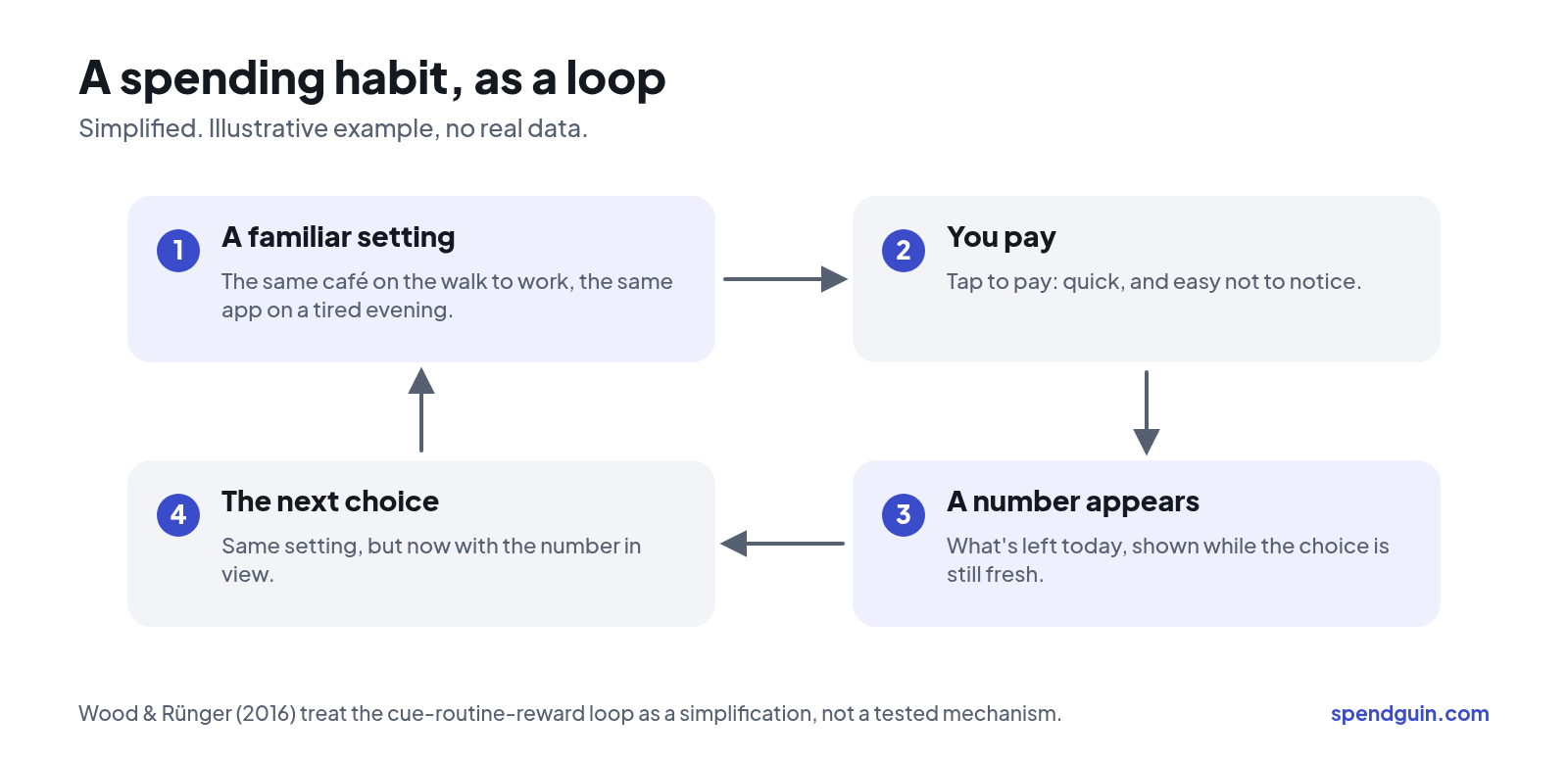 Figure 1. A simplified habit loop applied to spending. Illustrative, based on Wood & Rünger (2016); the "loop" is a simplification, not a tested mechanism.
Seven steps to change a spending habit
1. Watch first, for two weeks
Before you change anything, see what actually happens: where, when and how often. Monitoring progress has a real but modest track record. A meta-analysis of 138 randomized trials (19,951 participants) found that prompting people to monitor their progress improved goal attainment (d = 0.40), more so when progress was recorded or made public (Harkin et al., 2016). Those trials weren't all about money, but the lesson carries: you can only adjust what you can see.
2. Pick one habit, not five
Choose the one habit that matters most to you, such as weekday lunches out or late-night online orders. BJ Fogg's behavior model treats ability as a lever: the easier a behavior is, the more likely it happens when prompted (Fogg, 2009). Changing one thing is easier than overhauling a whole budget.
3. Change the setting, not just your intentions
Because habits are cued by context, changing the context is often more effective than resolving to try harder. Wendy Wood describes adding friction to unwanted behaviors and removing it from wanted ones (Wood, 2019, and APA interview). In money terms: delete a saved card from a shopping app, take a different route past the coffee shop, or keep a lunch option at work.
4. Decide in advance what you'll do instead
An if-then plan, such as "if I open the delivery app after 9 p.m., then I check today's number first", is called an implementation intention. A meta-analysis of 94 independent tests found a medium-to-large effect on goal attainment (d = 0.65) (Gollwitzer & Sheeran, 2006). Write one or two, not ten.
5. Get feedback at the moment you spend
A month-end statement arrives long after the habit has run. A number you see at the moment of choice, such as what's left to spend today, puts the feedback where the habit is. Our real-time spending tracker guide explains how to tell whether a tool really does this, and the daily spending limit guide shows how to set that number.
Be honest about tone. In a working paper on 55,586 users of a Canadian bank's app, people who got an overspending message spent about 5% less the next day, but also logged in less afterward (Lee, 2019). Feedback that feels like a scolding gets avoided.
6. Make the better option automatic
Some money habits are best not left to daily choices at all. Moving savings on payday means the decision is made once. The best-known evidence is Save More Tomorrow, where employees committed in advance to save part of future raises and their average savings rate rose from 3.5% to 13.6% over 40 months; it wasn't randomized, and the US Department of Labor's CLEAR review rates the causal evidence as low (Thaler & Benartzi, 2004).
7. Plan for the slip
You will have a bad day. In dieting research, people who see a strict rule as broken often abandon it, sometimes called the "what-the-hell effect" (Polivy & Herman, 1985); the money parallel is an analogy, not a finding. Decide now what a slip means: one day over, not a failed month. Lally's participants missed days and still formed the habit. The how to stick to a budget guide has a step-by-step plan for the day after.
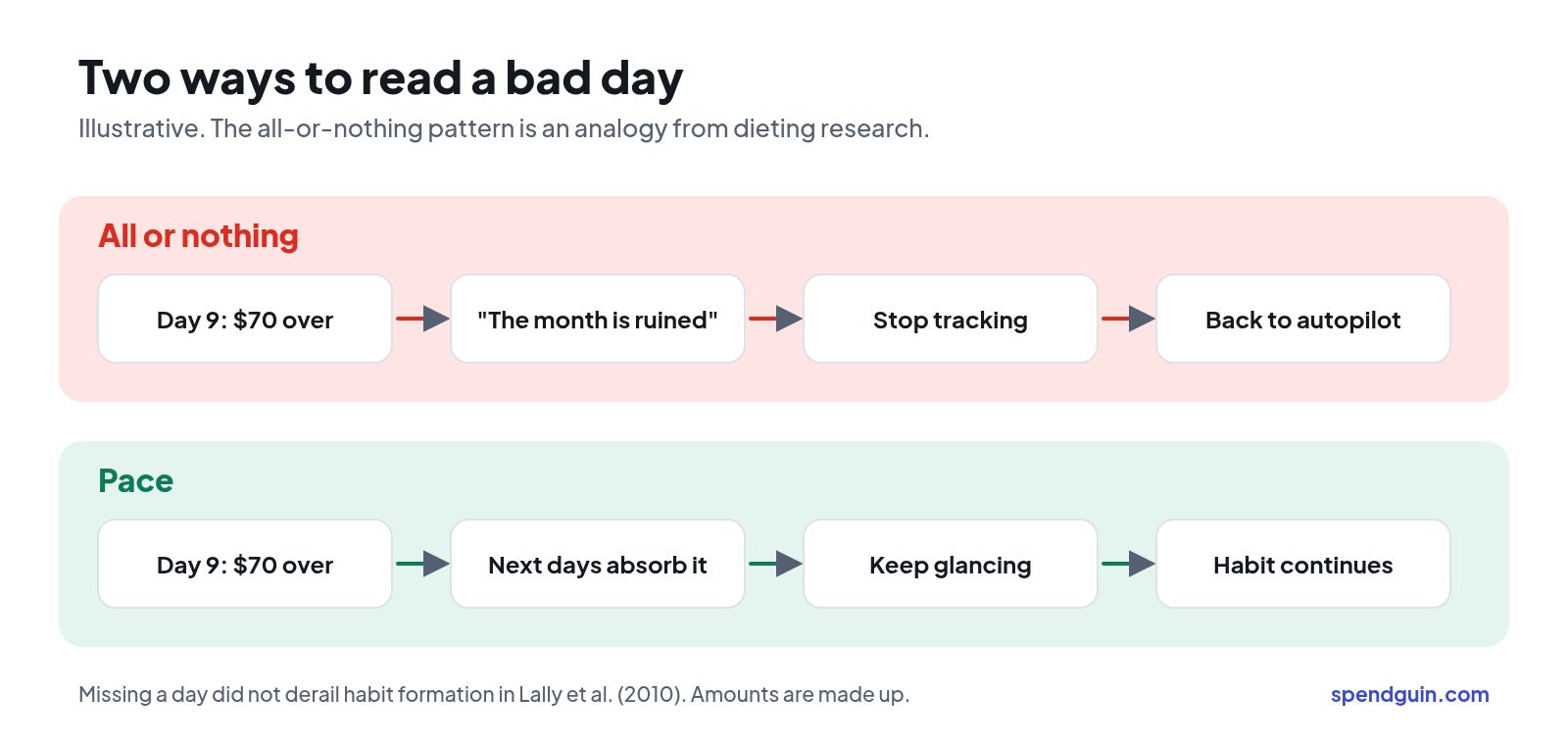 Figure 2. Two ways to read a bad day. Illustrative; the all-or-nothing pattern is drawn from dieting research and used as an analogy.
What about willpower and motivation?
Willpower helps, but it's a poor daily plan. A set of studies found that the benefits of self-control showed up largely through beneficial habits, not constant resistance (Galla & Duckworth, 2015). Motivation also fades. In a survey of people who had stopped using tracking tools, some said tracking surfaced uncomfortable feelings; one "felt guilty every time I tracked an expense" (Epstein et al., 2016). That's an argument for kind, simple feedback rather than more resolve. If the system itself feels like too much, see budgeting feels too complicated.
Small money habits worth trying
These are suggestions, not research findings. Pick one:
- Glance at today's number before any purchase you didn't plan.
- Take a five-minute look at the week every Sunday, then stop.
- Move savings automatically on payday.
- Keep one "free spending" amount for the pay period and stop tracking what's inside it.
- Wait a day before buying anything over an amount you choose.
- If you share spending with a partner, agree on one number for the pay period and look at it together once a week. See couples budgeting without merging everything.
Where Spendguin fits, and where it doesn't
Spendguin is built around two ideas from this guide: feedback at the moment you spend, and as little effort as possible.
- You set one spending target for your pay period (monthly, twice a month, weekly, or every 2 weeks), and Spendguin turns it into a daily amount.
- It picks up purchases from your Google Wallet and bank-app notifications. There's nothing to type, and it never connects to your bank account (no bank login).
- Overspend today and it comes off the days after, within the same pay period. A new period starts fresh: leftover money doesn't roll into it.
- Free: the daily Today screen; alerts on every purchase, when you're getting close to today's amount and when you're over it; the "Recurring?" prompt; refund alerts; 30 days of history; and Together, partner sharing for two people.
- Pro ($4.99 a month or $39.99 a year in USD or CAD, after a 30-day free trial with no card needed, starting when the first purchase notification arrives): spreading a big purchase over several pay periods, a heads-up the day before a recurring charge, a nightly recap and a Monday week-ahead, a choice when a period ends over (spread the overspend across the new period or take it off day one), and full history. Pro features show as locked on Free.
What it doesn't do: it's Android only, it needs notification access, and it can only see what alerts show, so cash and anything without an alert has to be added by hand. It tracks spending you've already made. It doesn't move money or give financial advice. And it hasn't been tested in a controlled trial; we built it on ideas from behavior science, not proof that it changes behavior.
Sources
- Wood, W., & Neal, D. T. (2007). A new look at habits and the habit-goal interface. Psychological Review, 114(4), 843-863. Accessed .
- Wood, W., Quinn, J. M., & Kashy, D. A. (2002). Habits in everyday life: Thought, emotion, and action. Journal of Personality and Social Psychology, 83(6), 1281-1297. Accessed .
- Wood, W., & Rünger, D. (2016). Psychology of habit. Annual Review of Psychology, 67, 289-314. Accessed .
- Wood, W. (2019). Good Habits, Bad Habits (book), and Wood's interview on the APA podcast Speaking of Psychology (secondary source). Accessed .
- Lally, P., van Jaarsveld, C. H. M., Potts, H. W. W., & Wardle, J. (2010). How are habits formed: Modelling habit formation in the real world. European Journal of Social Psychology, 40(6), 998-1009. Accessed .
- Harkin, B., et al. (2016). Does monitoring goal progress promote goal attainment? A meta-analysis of the experimental evidence. Psychological Bulletin, 142(2), 198-229. Accessed .
- Gollwitzer, P. M., & Sheeran, P. (2006). Implementation intentions and goal achievement: A meta-analysis of effects and processes. Advances in Experimental Social Psychology, 38, 69-119. Accessed .
- Fogg, B. J. (2009). A behavior model for persuasive design. Proceedings of Persuasive '09, ACM. Accessed .
- Galla, B. M., & Duckworth, A. L. (2015). More than resisting temptation: Beneficial habits mediate the relationship between self-control and positive life outcomes. Journal of Personality and Social Psychology, 109(3), 508-525. Accessed .
- Soman, D. (2001). Effects of payment mechanism on spending behavior: The role of rehearsal and immediacy of payments. Journal of Consumer Research, 27(4), 460-474. Accessed .
- Prelec, D., & Loewenstein, G. (1998). The red and the black: Mental accounting of savings and debt. Marketing Science, 17(1), 4-28. Accessed .
- Polivy, J., & Herman, C. P. (1985). Dieting and binging: A causal analysis. American Psychologist, 40(2), 193-201. (Dieting research, used as an analogy only.) Accessed .
- Thaler, R. H., & Benartzi, S. (2004). Save More Tomorrow: Using behavioral economics to increase employee saving. Journal of Political Economy, 112(S1), S164-S187. (Not randomized; rated low causal quality by the US Department of Labor CLEAR.) Accessed .
- Lee, S. K. (2019). Overspending messages and personal finance management (shortened title). SSRN working paper, not peer reviewed. Accessed .
- Epstein, D. A., et al. (2016). Beyond abandonment to next steps: Understanding and designing for life after personal informatics tool use. CHI 2016 (survey, n = 193). Accessed .
- Spendguin help center: What's left today; Going over today. Accessed .
FAQ
How do I change my spending habits?
Start by watching your spending for a couple of weeks without judging it, then pick one habit to change, not five. Change the setting that triggers it, decide in advance what you'll do instead (an if-then plan), get feedback at the moment you spend, and plan for the day you slip. Research supports monitoring and if-then plans; no single method works for everyone.
How long does it take to build a money habit?
Plan on about two months, with a wide range. In one study of everyday behaviors, the median time to reach near-peak automaticity was 66 days, ranging from 18 to 254 days, and missing a single day did not derail the process. The study wasn't about money, so treat it as a rough guide.
What are bad spending habits?
Common ones are spending on autopilot in the same places and times, paying without seeing the running total, letting small repeat purchases add up, and treating one overspend as a reason to give up for the month. What counts as bad depends on your goals; the useful question is which habit you'd most like to change first.
Is willpower enough to change spending habits?
Usually not for long. A set of studies found that people high in self-control did well mainly through beneficial habits rather than constant resistance. It's more reliable to change the setting, make the better option easier and get feedback in the moment than to count on resisting every day.
Can an app change my spending habits?
An app can make spending more visible and reduce effort, which fits the research on monitoring and feedback timing, but no app is proven to change habits, and we don't claim Spendguin does. Whether it helps depends on whether you keep looking at the number.
Spendguin shows what’s left to spend today by reading the purchase alerts you already get. No bank login.