Why budgets fail: the feedback delay problem
Why late, effortful feedback sinks a budget, and what the research says about simpler, faster feedback.
Try it for free on Google Play
Spenny the penguin would like a word about rear-view mirrors. Read on. 🐧
Full disclosure: we make Spendguin, an Android app built around this idea. That's a reason to be careful here, not a reason to oversell. Where the research is mixed, we say so. No study has tested Spendguin itself.
The short version
- Late feedback is weak feedback. Learning research finds that the longer the gap between an action and its consequence, the weaker the learning, especially when nothing marks the gap (Lattal, 2010). A month-end spending summary is about as delayed as feedback gets.
- Watching your progress helps you reach goals. A meta-analysis of 138 randomized trials (19,951 participants) found that prompting people to monitor their progress improved goal attainment, with a small-to-moderate effect, and more so when the progress was recorded (Harkin et al., 2016).
- Immediate feedback has changed real behavior, modestly. Real-time displays cut household energy use by roughly 5–15% in one major review (Darby, 2006), though the best-controlled studies find smaller effects, nearer 2% (UCL review of Delmas et al., 2013).
- Effort is why people quit. Nearly half of people who try personal finance apps stop, and manual categorizing is named as a burden (Lush, Meagher & Fontes, 2020).
- None of this is a guarantee. Feedback can backfire, a one-number budget showed no effect in one large test, and habits take weeks to months. Details below.
If you are shopping for a tool rather than reading the research, start with what a real-time spending tracker is and how to tell if one is real time.
A monthly budget is a rear-view mirror
Picture someone we'll call Alex. (Alex is made up, and so are the numbers. They're here to make the idea concrete.)
Alex gets paid on the 1st and sets a plan: roughly $60 a day for everything that isn't a fixed bill. On the 30th, Alex opens a report. It says dining out came to $412 and groceries to $540. Alex nods, feels a little guilty, and thinks, I'll do better next month.
Here's the problem. By the time the report exists, every one of those decisions is weeks old. There's nothing to adjust. The information is accurate and it's useless for changing anything.
Now picture the same month, but Alex can see one number whenever a purchase happens: what's left to spend today. On the 9th, a $24 lunch means $11 left for the day. The consequence is visible right when the choice is fresh, and tomorrow's number is still adjustable.
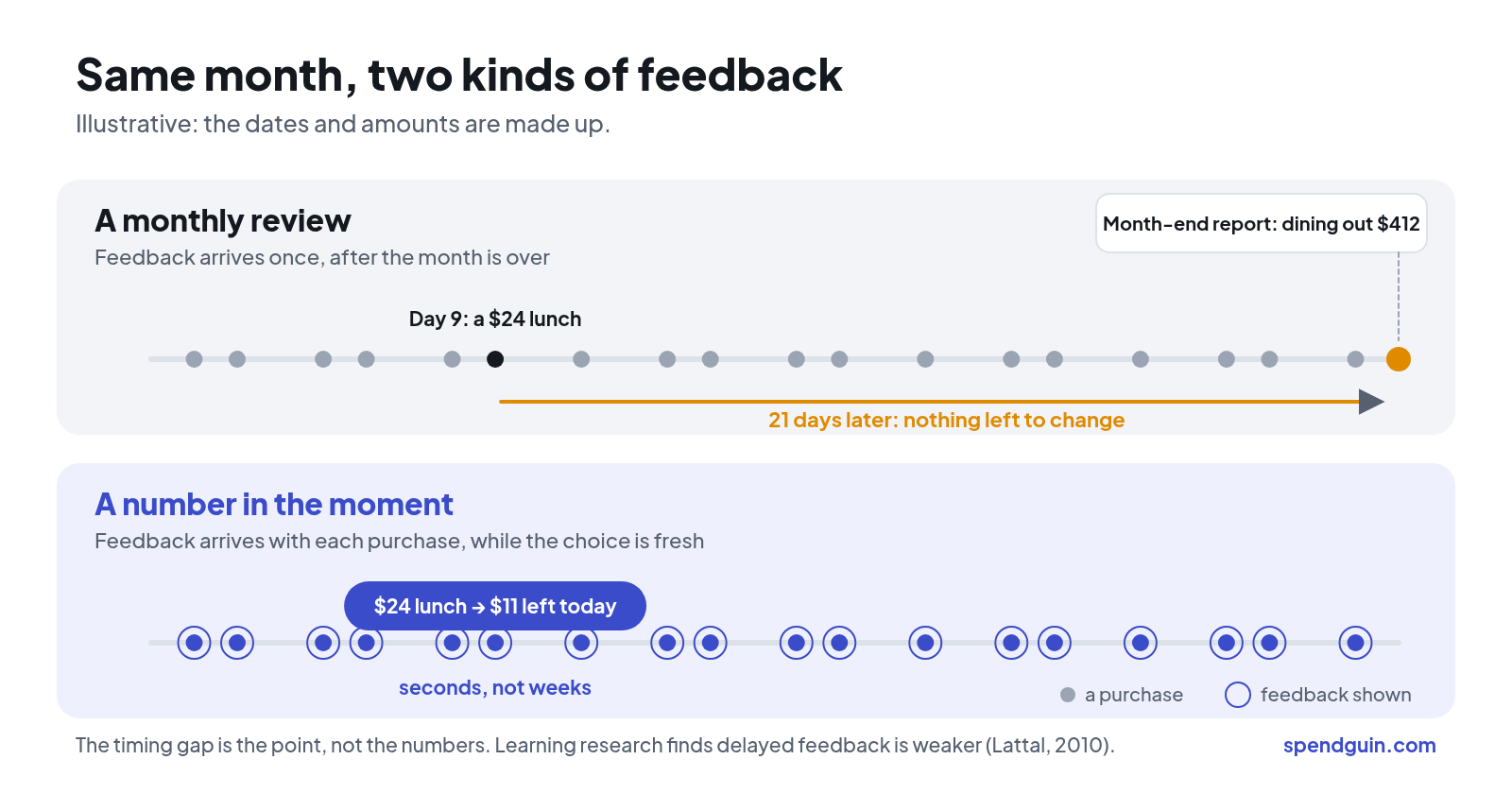 Figure 1. The same month, two kinds of feedback. Dates and amounts are made up; the gap in timing is the point.
Reviewing last month isn't worthless. It's good for planning, noticing patterns and setting next month's target. That's our view, not a research finding. But planning and changing a habit are different jobs. The research below is mostly about the second one.
Spenny's note: A rear-view mirror is great for knowing where you've been. It's a poor way to steer. You'd like both, please. 🐧
What the research says about feedback timing
Delay weakens learning (in the lab)
In experimental psychology, there's a long line of work on the delay-of-reinforcement gradient: the longer the gap between a behavior and its consequence, the weaker the effect on that behavior. Lattal's 2010 review in the Journal of the Experimental Analysis of Behavior covers the research, and notes that the drop is steeper when nothing signals the delay (Lattal, 2010).
Caveat: this work is largely from animal and laboratory settings. People can think about future consequences, so we can't assume a pigeon's learning curve applies to a person with a budget. Treat it as a reason to take timing seriously, not as proof.
Rewards matter most when a habit is forming
Wendy Wood and David Neal's research programme describes habits as automatic responses that build up when we repeat a behavior in a stable context (Wood & Neal, 2007). In everyday life, a large share of what we do is habitual: one diary study found around 43% of daily behaviors were performed almost daily in the same place (Wood, Quinn & Kashy, 2002). In a later review, Wood and Rünger conclude that rewards matter most while a habit is being acquired (Wood & Rünger, 2016).
You may have heard of the "cue, routine, reward" habit loop popularized by Charles Duhigg's 2012 book The Power of Habit. It's a handy mental model. The research reviews treat it as a simplification rather than a fully tested mechanism, so we use it loosely here.
The takeaway: if feedback is meant to help build a spending habit, it should show up close to the moment of the purchase, not at the end of the month.
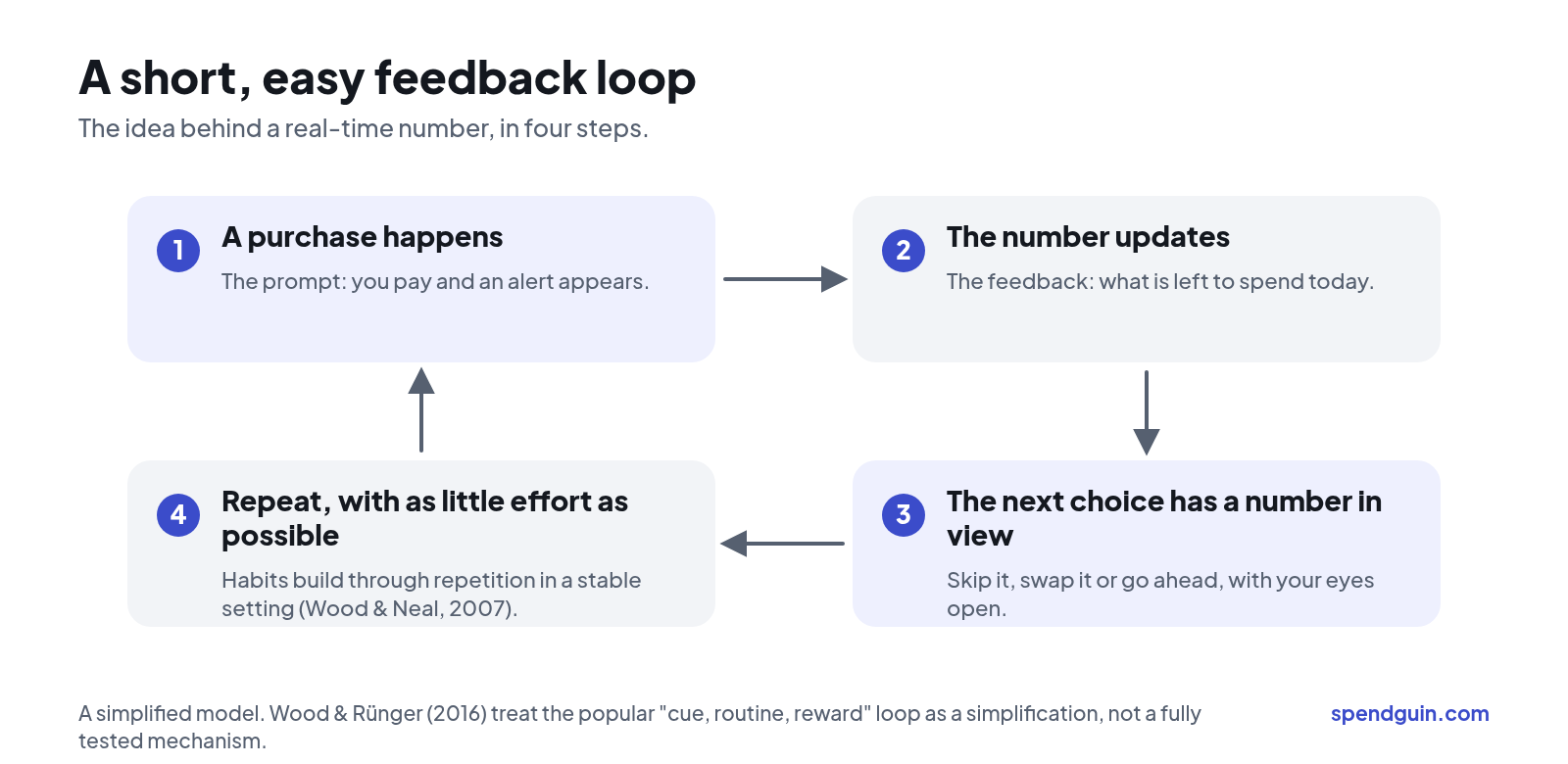 Figure 2. A short, easy feedback loop. A simplified model: researchers treat the popular cue, routine, reward loop as a simplification (Wood & Rünger, 2016).
Prompts need to be easy, too
BJ Fogg's behavior model says a behavior happens when motivation, ability and a prompt come together at the same moment (Fogg, 2009). In our view, a once-a-month report is a weak prompt: it arrives at one moment, when the spending is long done, and there is nothing left to act on. A number you glance at in the moment is a different prompt at a different time. (That reading is ours, not Fogg's.)
Real-time feedback outside money
The best-studied real-time feedback comes from energy use:
- A review of feedback studies found that direct feedback (from a meter or display, available immediately) was associated with savings of about 5–15%, while indirect feedback such as a later bill was associated with 0–10% (Darby, 2006).
- In a field experiment, hotel guests who saw their energy use per shower in real time used 11.4% less energy per shower, in a study designed to avoid the bias of people volunteering (Tiefenbeck et al., 2018, Nature Energy).
- Caveat: a broader meta-analysis found an average saving of 7.4%, falling to about 2% in the most rigorous studies, as summarized in a UCL evidence review (Delmas et al., 2013, as summarized by UCL). Energy is also not money. Treat these as a signal that immediacy can matter, not as a forecast for your spending.
Self-monitoring works, if you actually do it
Self-monitoring just means tracking your own behavior against a goal. It's one of the most-studied techniques in behavior change, and it has its own entry ("self-monitoring of behaviour") in the standard taxonomy of behavior change techniques (Michie et al., 2013).
- The positive evidence. Harkin and colleagues pooled 138 randomized trials with 19,951 participants. Interventions that prompted people to monitor their goal progress improved goal attainment (d = 0.40, a small-to-moderate effect), and the benefit was larger when progress was physically recorded or reported to others (Harkin et al., 2016). An earlier meta-regression of healthy-eating and physical-activity interventions found that those combining self-monitoring with at least one other technique from control theory (such as goal setting or feedback) had larger effects: d = 0.42 versus 0.26 (Michie et al., 2009). That study compares across trials rather than randomizing techniques, so it's suggestive, not conclusive.
- The counter-example. In a large trial of weight loss, adding a wearable activity tracker to a behavioral program led to less weight loss at 24 months (3.5 kg versus 5.9 kg, P = .002) than self-monitoring without it (Jakicic et al., 2016, JAMA). More data isn't automatically better.
The fair reading: monitoring helps when people keep doing it and when it's tied to a goal. It doesn't help when the tool adds burden or becomes background noise.
Why spending is so easy to not see
Money is unusually good at hiding. Three well-known ideas help explain why:
- Paying doesn't always feel like paying. Prelec and Loewenstein proposed that people feel a "pain of paying" that's strongest when payment is closely tied to what they're buying, and weaker when the two are decoupled, as with cards (Prelec & Loewenstein, 1998). Soman found that how people pay changes both how well they recall past payments and how much those payments weigh on later purchase decisions. Past payments reduced purchase intention more when the payment method required writing down the amount and when wealth was depleted immediately rather than later (Soman, 2001). Our inference: tap-to-pay is built to be frictionless, which is great at checkout and not so great for awareness.
- We keep mental budgets. Consumers set budgets for categories of spending and track against them, and this affects later purchases (Heath & Soll, 1996). The catch is that those mental budgets are only as good as our memory of what we've spent.
- Now beats later. Economists have shown that people systematically overweight the present against the future (Laibson, 1997; O'Donoghue & Rabin, 1999). A purchase today has an immediate payoff. The consequence on the budget shows up a month later and feels abstract.
Put together: spending feels painless, memory of it fades, and the consequence sits far in the future. That's the setup a real-time number is trying to counter.
What real-time feedback has done in money studies
The money-specific evidence is smaller and newer than the energy research, and it's mixed. Here's what's actually been found.
- A bank-app overspending message. In a working paper using data from 55,586 users of a Canadian bank's money-management app, people who received a message about overspending reduced spending the next day by C$8.15, about 5.4% of their average daily spending, compared with non-recipients. The reduction persisted in cumulative spending. But recipients also logged in less afterward, a pattern the author calls the "ostrich effect" (Lee, 2019, working paper). It's a working paper, so it hasn't gone through the same peer review as a journal article, and the message appeared on the following day.
- A salience app for credit-card customers. In a field experiment, weekly feedback on goals, alongside making transactions more visible, was linked to lower credit-card spending, but only when the feedback covered both ordinary and exceptional purchases. The authors report one group spending 13.1 percentage points less than control by one measure, but their formal comparison, a difference in medians of 6.0 percentage points, was only marginally significant (p = .10), though the overall test across groups was significant (p = .049). Feedback was weekly, not real-time. The authors flag limitations including possible Hawthorne effects (Huebner, Fleisch & Ilic, 2020). One takeaway is that incomplete data seems to weaken the effect: the picture has to be reasonably whole.
- Reminders and savings. Reminders raised savings balances by about 6% across a set of field experiments in three countries. In Peru, reminders that named a specific savings goal raised savings by 16%, while generic reminders had no significant effect (Karlan, McConnell, Mullainathan & Zinman, 2016).
- Reminders and side effects. In a Brazilian field experiment, payment reminders cut credit card late fees by 14%, but increased overdraft fees by 9%, and users with an overdraft history ended up paying 5% more in total fees, while others saved 15% (Medina, 2021).
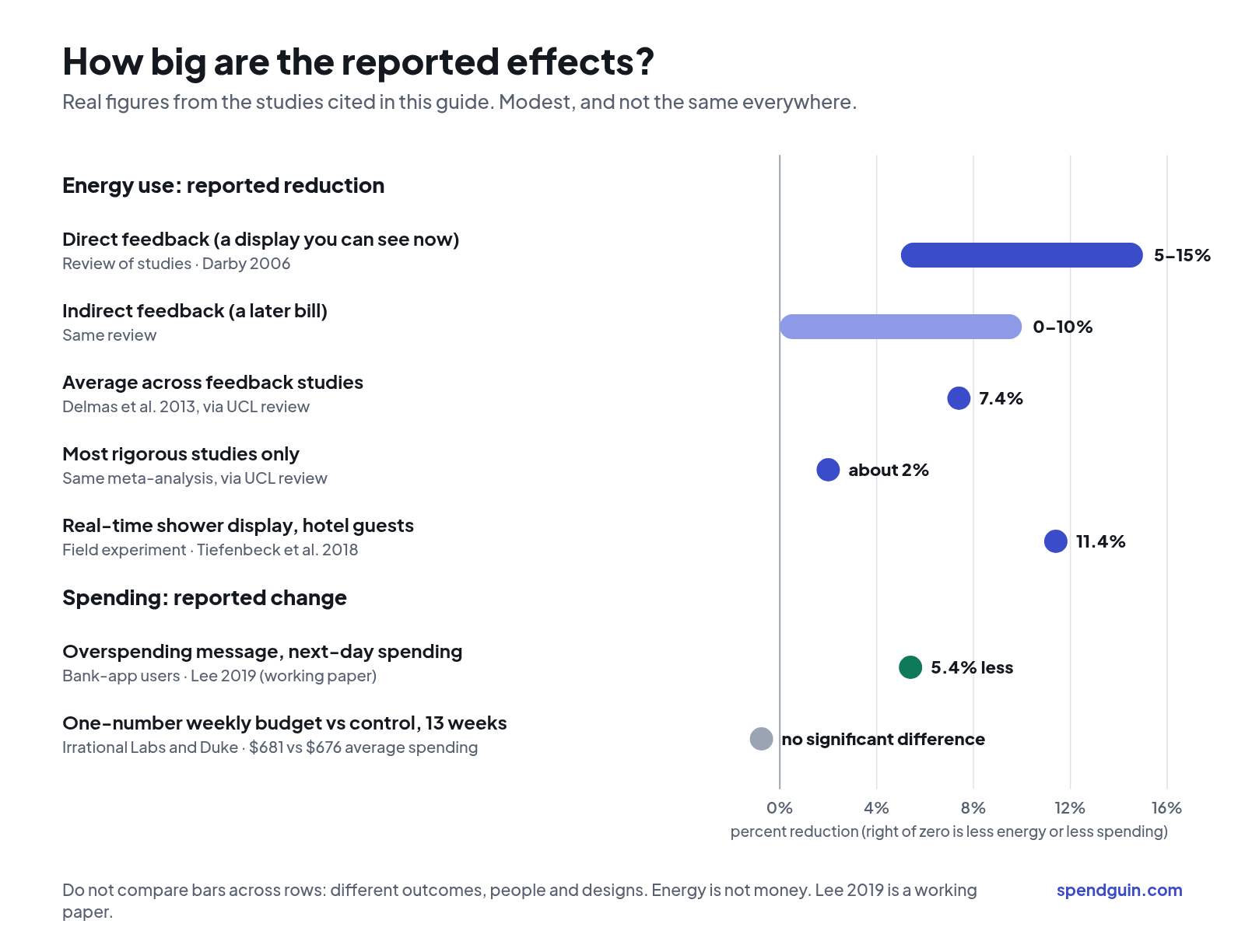 Figure 3. Reported effects from the studies cited above, drawn from their published figures. Do not compare across rows: the outcomes, people and designs differ. Energy is not money, and Lee (2019) is a working paper.
The honest summary: timely information about spending can move behavior a little, in some people, under some conditions. The effects we have are single-digit percentages, not transformations.
When feedback backfires
This is the part most "habit hack" articles skip, so we want to be clear about it.
- Precise feedback can make people spend the surplus. In a technical report on budget monitoring, Ghosh and Huang found that giving people precise, real-time budget feedback could increase spending late in a budget period when they had money left over, because it reduced their uncertainty about how much they could safely spend. The effect was weaker with rollovers, shorter budget windows and less precise information (Ghosh & Huang, 2020, technical report for the Think Forward Initiative). Design matters: short windows and carry-forward rules help, and a long window with a big pile of unspent money does not.
- People avoid information that feels bad. Lee's bank-app study found message recipients checked their accounts less afterward (Lee, 2019). A survey of people who had stopped tracking, including finances, found that for some, tracking surfaced uncomfortable feelings: one participant "felt guilty every time I tracked an expense" (Epstein et al., 2016). Tone matters. Feedback that scolds gets avoided.
- Reminders can have side effects. See Medina above: the same reminder helped some people and cost others (Medina, 2021).
- A one-number budget didn't change spending in one big test. Irrational Labs and Duke's Common Cents Lab ran a 13-week experiment with 9,035 users of a budgeting app. Neither a single weekly "one number" budget nor a category budget changed average spending (about $676 for the control group, $681 for one-number and $673 for category budgets, all differences not significant). 84% of the users given a budget looked at it five times or fewer over the 13 weeks, and engagement fell over time (Irrational Labs: Budgeting, what our research uncovered; Common Cents Lab report). One reasonable reading is that a number only helps if people actually see it, in the moment, again and again. That's a hypothesis, not a result from that study.
If a product tells you its approach is "scientifically proven to change your habits," be skeptical. It's more accurate to say these ideas are supported by research under certain conditions.
Budgets fail for other reasons too (and feedback can't fix all of them)
Most "why budgets fail" guides list the same planning problems, and they are real. Real-time feedback speaks to some of them and not to others, so here is where it helps and where it doesn't.
| Common reason | What the evidence says | Does real-time feedback help? |
|---|---|---|
| Numbers were guessed, not observed | Consistent with the self-monitoring research above: you can only adjust to what you can see. | Partly. It replaces guesses with real numbers, but only if you keep logging. |
| Costs that aren't monthly, and income that swings | In a Chase account sample (2013-2014), 89% of people saw average monthly income changes above 5%, and every person saw monthly spending changes above 5%; drivers included months with five paydays, tax bills and year-end shopping (J.P. Morgan Chase Institute, 2015). | Not by itself. This is a planning problem: set money aside for these costs ahead of time. |
| No cushion | 63% of US adults said they could cover a $400 emergency with cash or its equivalent, and 13% said they could not pay it by any means (Federal Reserve, 2025). | No. A daily number can't create a buffer. |
| All-or-nothing reaction to one overspend | In dieting research, people who see a strict rule as broken often abandon it, called the "what-the-hell effect" (Polivy & Herman, 1985). The budgeting parallel is an analogy, not a finding from money studies. | It can go either way. A number that forgives one bad day helps; a harsh limit may make it worse (see how to stick to a budget). |
| Too many categories to maintain | See the abandonment data below. | Only if capturing spending is easy (simple budget app guide). |
| Saving "whatever is left" | Employees who agreed in advance to put part of future raises into savings raised their average rate from 3.5% to 13.6% over 40 months. The program was not randomized, and the US Department of Labor's CLEAR review rates the causal evidence as low (Thaler & Benartzi, 2004). | No. Automatic transfers do this better than any alert. |
The honest takeaway: feedback addresses the "I can't see it" part of budgeting. A cushion, a plan for non-monthly costs and automatic saving are separate jobs. Spendguin doesn't do them for you; it isn't a savings or bill-planning tool. (Spreading one big purchase over several pay periods is a Pro feature, see below.)
Simplicity: the other half of the habit
Real-time feedback only works if you keep doing it, and people keep doing what's easy. The simple budget app guide goes deeper on what "simple" means in practice. If your current budget feels like too much, see budgeting feels too complicated.
Ability is a lever, not an afterthought
Fogg's model treats ability, how easy something is to do, as one of three ingredients of behavior, alongside motivation and prompts. In his 2009 paper he lists six elements of simplicity: time, money, physical effort, mental effort ("brain cycles"), social deviance and non-routine (Fogg, 2009). Every extra step in a budgeting system, such as linking accounts, creating categories, tagging purchases or reconciling, costs some of those.
Wendy Wood makes a similar argument from habit research: friction, meaning how difficult a behavior is to perform, strongly shapes whether it's repeated and whether it turns into a habit, and shifting the environment often works better than relying on willpower (Wood, interviewed by APA; Wharton Magazine). Those are interviews summarizing her book Good Habits, Bad Habits (2019), so we cite them as her stated view rather than a single experiment.
What the abandonment data shows
- A nationally representative survey of 1,059 US adults found that only 12% had ever used a third-party personal finance app or website, and that almost half of those users had stopped. The most common reason for non-use or stopping was a perceived lack of value. The authors also note that many tracking and budgeting apps require manual categorizing, which imposes "significant time and cognitive burdens" before people get any insight (Lush, Meagher & Fontes, 2020).
- In a survey of 193 people who had stopped tracking, the cost of tracking was a leading reason people quit, and manual entry was a common thread. People called tracking "a hassle." Financial trackers sometimes described it as taking up time they didn't have (Epstein et al., 2016). Earlier work on self-tracking tools identified barriers at the data-collection stage as a major source of drop-off (Li, Dey & Forlizzi, 2010).
Caveats: these are surveys, so they show what people say, not what a design change would do. The 2016 study had a small, online sample. And "lack of perceived value" means effort isn't the only reason people quit.
What about "too many choices"?
You might be tempted to cite the famous jam study, in which shoppers offered 24 jams were less likely to buy than shoppers offered 6 (about 3% versus 30% bought) (Iyengar & Lepper, 2000). We'd rather not lean on it. A later meta-analysis of 50 experiments found the average effect of choice overload was close to zero (D = 0.02), with the effect showing up only under certain conditions (Scheibehenne, Greifeneder & Todd, 2010). So we don't claim that fewer features is always better. The narrower claim is the one the abandonment research supports: the effort of keeping up is a documented reason people stop.
How long a habit takes
If you're hoping for a 21-day fix, the best-known study of real-world habit formation says to plan on longer. In a study that followed volunteers as they adopted a new daily behavior, the median time to reach near-peak automaticity was 66 days, with a range from 18 to 254 days (these figures come from the 39 people whose data fit the model well) (Lally et al., 2010). Missing a single day didn't derail the process.
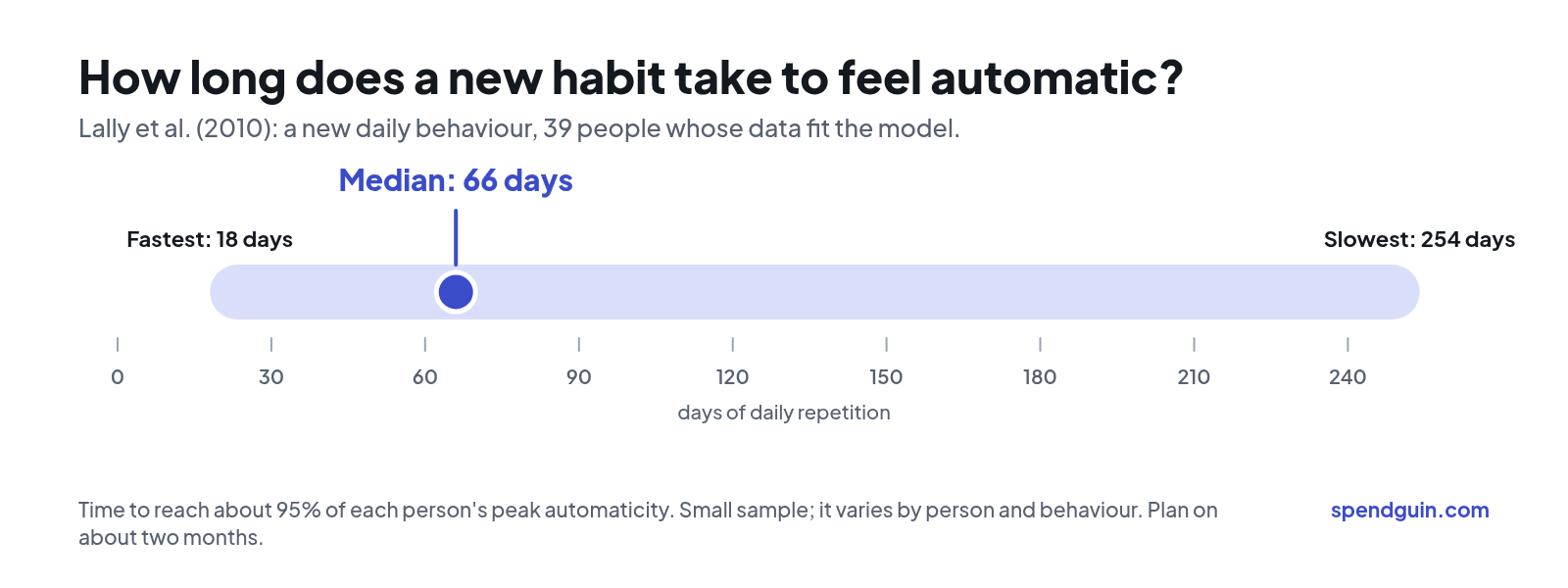 Figure 4. Time to reach near-peak automaticity in Lally et al. (2010): median 66 days, range 18 to 254, among the 39 people whose data fit the model.
For a spending habit, that suggests treating the first two months as practice, not a verdict. For turning this into a money habit step by step, see how to change your spending habits.
How to build a feedback habit (with any tool)
You don't need our app for any of this. The ideas hold whether you use a notebook, a spreadsheet or a bank's own app. For the step-by-step version, including what to do after a bad day, see how to stick to a budget.
- Pick one number. Take your monthly spending money (income minus fixed bills and savings) and divide it by the days in your pay period. That's your "left today" number. Keep it to a single figure so there's less to think about. The daily spending limit guide walks through the arithmetic with an example.
- Make capturing spending automatic or nearly so. Every manual step is a chance to quit. If you track by hand, keep it to amount-only for the first month.
- Look at the number at the moment of spending. Check it before a discretionary purchase, not after. The point is feedback while the choice is still open.
- Use a short window and carry the difference. Short windows with rollover are the design that reduced "spend the surplus" effects in Ghosh and Huang's work. Underspend today and tomorrow's number grows. Overspend and tomorrow's shrinks.
- Keep the tone kind. If seeing the number feels like being scolded, you'll avoid it. A bad day is data, not a verdict.
- Do a light weekly check, and a monthly planning session. Daily feedback for the habit, weekly glance for trends, monthly review for planning. This split is our suggestion.
- Give it about two months before deciding whether it works for you.
Spenny's note: One number, checked often, kindly. That's the whole trick. 🐧
Where Spendguin fits, and where it doesn't
Spendguin is an Android app built around the two ideas in this guide: feedback in the moment and as little effort as possible.
- You set one spending target for your pay period (monthly, twice a month, weekly, or every 2 weeks), and Spendguin turns it into a daily amount.
- It picks up purchases from your Google Wallet and bank-app notifications, so there's nothing to type and you never hand over a bank password.
- It shows what's left to spend today. If you overspend, it comes off tomorrow, and spending less pays that back first. That all happens inside one pay period. A new period starts fresh: leftover money doesn't roll into it, and if you ended over, Free starts fresh and Pro can spread the overspend across the new period or take it off day one.
- It alerts you on every purchase, when you're getting close to today's amount, and when you're over it. Those alerts are free.
- A History view shows each day against what you had to spend (Free shows the last 30 days; older history is Pro).
What it doesn't do, honestly:
- It's Android only, and it needs purchase notifications turned on in Google Wallet or your bank app, plus notification access for Spendguin.
- It can only see what appears in those notifications. Cash, some transfers and anything that doesn't trigger an alert have to be added by hand, and a number that's missing purchases is less useful (remember the finding about complete pictures above).
- It tracks spending you've already made. It doesn't connect to your bank, move money or give financial advice.
- It hasn't been tested in a controlled trial. We built it on ideas from behavior science. We haven't proved it changes behavior, and we'd rather say that plainly.
Spendguin is free to start, partner sharing is free, and Pro is a paid subscription after a trial. Pro features show as locked on Free; the help center lists what is on each plan.
Sources
- Lattal, K. A. (2010). Delayed reinforcement of operant behavior. Journal of the Experimental Analysis of Behavior, 93(1), 129–139. [journal] Accessed .
- Wood, W., & Neal, D. T. (2007). A new look at habits and the habit-goal interface. Psychological Review, 114(4), 843–863. [journal] Accessed .
- Wood, W., Quinn, J. M., & Kashy, D. A. (2002). Habits in everyday life: Thought, emotion, and action. Journal of Personality and Social Psychology, 83(6), 1281–1297. [journal] Accessed .
- Wood, W., & Rünger, D. (2016). Psychology of habit. Annual Review of Psychology, 67, 289–314. [journal review] Accessed .
- Fogg, B. J. (2009). A behavior model for persuasive design. Proceedings of Persuasive '09, ACM. [conference paper] Accessed .
- Darby, S. (2006). The effectiveness of feedback on energy consumption. Environmental Change Institute, University of Oxford. [review report] Accessed .
- Tiefenbeck, V., Wörner, A., Schöb, S., Fleisch, E., & Staake, T. (2018; print 2019). Real-time feedback promotes energy conservation in the absence of volunteer selection bias and monetary incentives. Nature Energy, 4, 35–41. [journal] Accessed .
- Delmas, M. A., Fischlein, M., & Asensio, O. I. (2013). Information strategies and energy conservation behavior: A meta-analysis. Energy Policy. Cited here only as summarized in the UCL Energy Institute evidence review (we did not read the original). [secondary summary] Accessed .
- Harkin, B., et al. (2016). Does monitoring goal progress promote goal attainment? A meta-analysis of the experimental evidence. Psychological Bulletin, 142(2), 198–229. [journal] Accessed .
- Michie, S., Abraham, C., Whittington, C., McAteer, J., & Gupta, S. (2009). Effective techniques in healthy eating and physical activity interventions: A meta-regression. Health Psychology, 28(6), 690–701. [journal] Accessed .
- Michie, S., et al. (2013). The behavior change technique taxonomy (v1) of 93 hierarchically clustered techniques. Annals of Behavioral Medicine, 46, 81–95. [journal] Accessed .
- Jakicic, J. M., et al. (2016). Effect of wearable technology combined with a lifestyle intervention on long-term weight loss: The IDEA randomized clinical trial. JAMA, 316(11), 1161–1171. [journal] Accessed .
- Prelec, D., & Loewenstein, G. (1998). The red and the black: Mental accounting of savings and debt. Marketing Science, 17(1), 4–28. [journal] Accessed .
- Soman, D. (2001). Effects of payment mechanism on spending behavior: The role of rehearsal and immediacy of payments. Journal of Consumer Research, 27(4), 460–474. [journal] Accessed .
- Heath, C., & Soll, J. B. (1996). Mental budgeting and consumer decisions. Journal of Consumer Research, 23(1), 40–52. [journal] Accessed .
- Laibson, D. (1997). Golden eggs and hyperbolic discounting. Quarterly Journal of Economics, 112(2), 443–478. [journal] Accessed .
- O'Donoghue, T., & Rabin, M. (1999). Doing it now or later. American Economic Review, 89(1), 103–124. [journal] Accessed .
- Lee, S. K. (2019). Fintech nudges: Overspending messages and personal finance management. [working paper, SSRN] Accessed .
- Huebner, J., Fleisch, E., & Ilic, A. (2020). Assisting mental accounting using smartphones: Increasing the salience of credit card transactions helps consumer reduce their spending. Computers in Human Behavior, 113, 106504. [journal] Accessed .
- Karlan, D., McConnell, M., Mullainathan, S., & Zinman, J. (2016). Getting to the top of mind: How reminders increase saving. Management Science, 62(12), 3393–3411. [journal] Accessed .
- Medina, P. C. (2021). Side effects of nudging: Evidence from a randomized intervention in the credit card market. Review of Financial Studies, 34(5), 2580–2607. [journal; the title uses the word "nudging"] Accessed .
- Ghosh, A. P., & Huang, L. (2020). Dynamic budget monitoring: When access to budget feedback leads to increase in spending. Technical report for the Think Forward Initiative. [technical report, not peer reviewed] Accessed .
- Irrational Labs / Common Cents Lab. Budgeting: What our research uncovered. [industry-academic field experiment report] Accessed .
- Lush, M., Meagher, K., & Fontes, A. (2020). Personal financial management tools: Delivering on the promise of convenient financial well-being? Consumer Interests Annual, 66. [conference proceedings; survey, n = 1,059] Accessed .
- Epstein, D. A., Caraway, M., Johnston, C., Fogarty, J., Munson, S. A., et al. (2016). Beyond abandonment to next steps: Understanding and designing for life after personal informatics tool use. CHI 2016. [conference paper; survey n = 193] Accessed .
- Li, I., Dey, A., & Forlizzi, J. (2010). A stage-based model of personal informatics systems. CHI 2010. [conference paper] Accessed .
- Iyengar, S. S., & Lepper, M. R. (2000). When choice is demotivating: Can one desire too much of a good thing? Journal of Personality and Social Psychology, 79(6), 995–1006. [journal] Accessed .
- Scheibehenne, B., Greifeneder, R., & Todd, P. M. (2010). Can there ever be too many options? A meta-analytic review of choice overload. Journal of Consumer Research, 37(3), 409–425. [journal] Accessed .
- Lally, P., van Jaarsveld, C. H. M., Potts, H. W. W., & Wardle, J. (2010). How are habits formed: Modelling habit formation in the real world. European Journal of Social Psychology, 40(6), 998–1009. [journal] Accessed .
- Wood, W. (2019). Good Habits, Bad Habits (book; not quoted directly), and Wood's interview on the APA podcast [secondary] Accessed .
- J.P. Morgan Chase Institute (2015). Weathering Volatility: Big data on the financial ups and downs of U.S. individuals (Farrell & Greig). Accessed .
- Board of Governors of the Federal Reserve System (2025). Economic Well-Being of U.S. Households in 2024, Savings and Investments (SHED). Accessed .
- Polivy, J., & Herman, C. P. (1985). Dieting and binging: A causal analysis. American Psychologist, 40(2), 193-201. (Dieting research, used as an analogy only.) Accessed .
- Thaler, R. H., & Benartzi, S. (2004). Save More Tomorrow: Using behavioral economics to increase employee saving. Journal of Political Economy, 112(S1), S164-S187. (Not randomized; rated low causal quality by the US Department of Labor CLEAR.) Accessed .
FAQ
Does real-time spending feedback actually change behavior?
It can, modestly, and not for everyone. Real-time displays reduced household energy use by about 5–15% in one review, though the most rigorous studies found around 2%. In money, a bank-app overspending message cut next-day spending by about 5.4% in one working paper. A one-number weekly budget showed no effect in a large 13-week test where most people rarely looked at it. The evidence supports "can help under the right conditions," not "proven."
Is looking back at last month's spending useless?
No. It's useful for planning and spotting patterns. The point of this guide is narrower: a monthly review on its own is a weak tool for changing day-to-day habits, because the feedback comes long after the choices. Many people do best with both: a quick daily number and a monthly planning check-in. (That pairing is our suggestion, not a research finding.)
How long does it take to form a money habit?
In one well-known study of everyday behaviors, the median was 66 days, but it ranged from 18 to 254 days depending on the person and the behavior (Lally et al., 2010). Plan on a couple of months and don't read a missed day as failure.
Why do people quit budgeting apps?
Surveys point to perceived lack of value and the effort of keeping up, including manual categorizing (Lush et al., 2020; Epstein et al., 2016). Some people also stop because tracking makes them feel bad about their finances.
Is a simpler budget app better?
Simpler is easier to keep using, and keeping using it is what builds a habit. But "simpler produces better financial outcomes" hasn't been shown directly. The research on choice overload is mixed, so we stay with the narrower claim about effort and drop-off.
Does Spendguin change spending habits?
We don't know yet, and we won't claim it does. Spendguin is designed around feedback timing and simplicity, which research suggests are useful ingredients. We haven't run a controlled study of the app.
Why do budgets fail?
Usually for a mix of planning and behavior reasons: numbers that were guessed instead of observed, costs that are not monthly, no cushion for surprises, too many categories to keep up with, an all-or-nothing reaction to one overspend, and feedback that arrives a month late. Real-time feedback addresses the last one and can help with the first and fifth; it does not fix a missing cushion or forgotten annual bills.
Why does one surprise expense wreck a budget?
Because most budgets assume a smooth month and most households do not have one. In a Federal Reserve survey, 63% of US adults said they could cover a $400 emergency with cash or its equivalent, so for about 4 in 10 a surprise is borrowed, sold or unpaid. A Chase data study also found income and spending both swing month to month. A cushion and a plan for non-monthly costs do more here than any tracking feature.
Spendguin shows what’s left to spend today by reading the purchase alerts you already get. No bank login.